Projection welding is a highly efficient resistance welding process widely used in modern manufacturing for joining metal components with precision, repeatability, and high production speed. For industries such as automotive, HVAC, electrical equipment, and heavy machinery, projection welding offers a reliable solution for multi-point welds and complex assemblies.
As a global manufacturer of industrial welding and metal-joining systems, Heron Welder provides advanced projection welding machines, automation systems, and integrated welding solutions designed for high-volume production environments.
This article explores the working principle, applications, benefits, limitations, and best practices of projection welding, helping engineers and decision-makers understand how to optimize this process in modern manufacturing.
What Is Projection Welding?
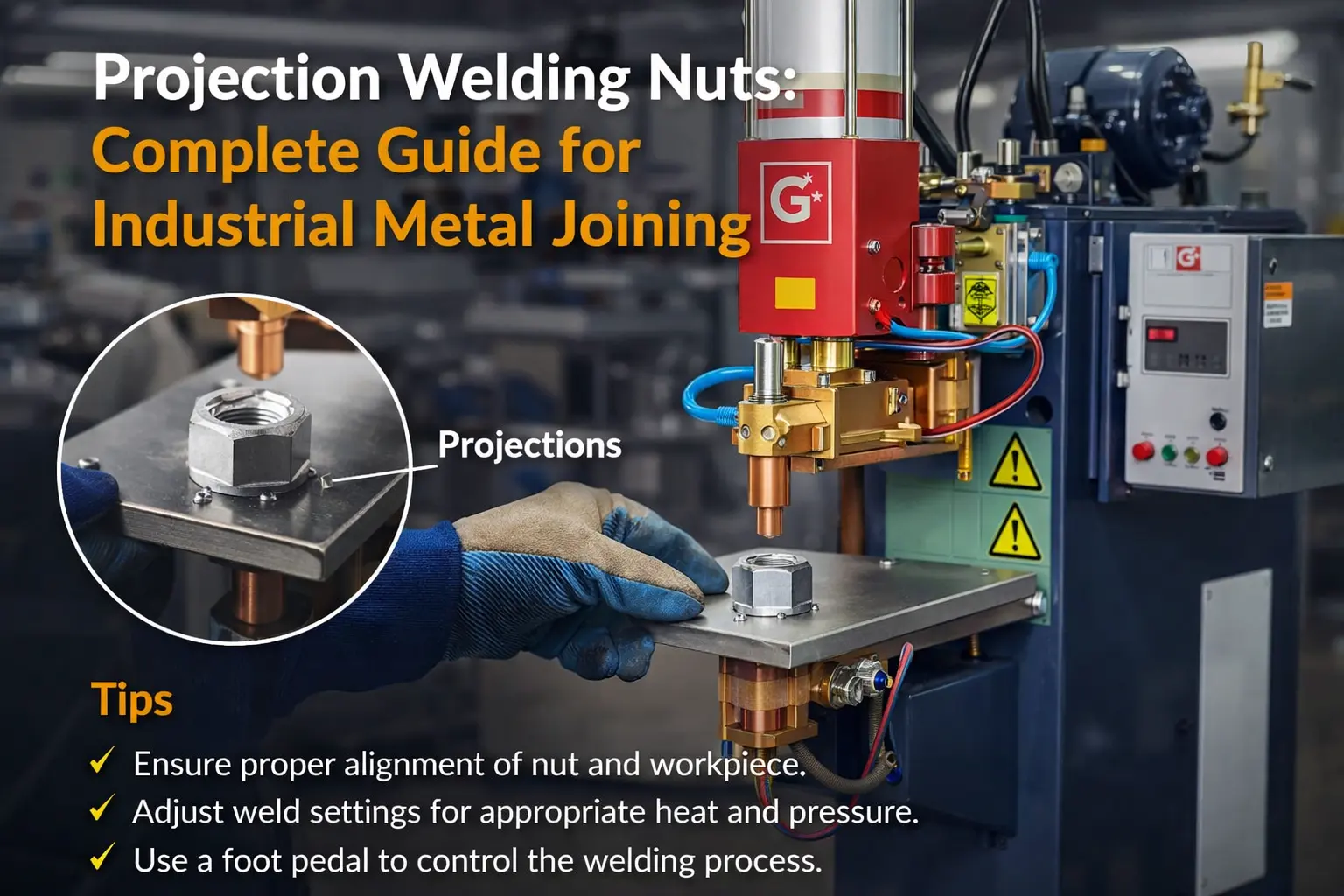
Projection welding is a resistance welding process in which localized projections (raised points or embossed features) on one or both workpieces concentrate welding current and pressure at specific locations. These projections collapse under heat and force, forming a strong and controlled weld joint.
Unlike traditional spot welding, where electrodes define the weld location, projection welding uses the geometry of the workpiece itself to determine weld points.
Key Concept
- Electrical resistance generates heat at projection points
- Pressure from electrodes collapses projections
- Multiple welds can be formed in a single cycle
This makes projection welding ideal for high-speed, repeatable production environments.
How Projection Welding Works
The projection welding process follows a structured cycle:
1. Part Preparation
Workpieces are designed with small projections (embossed bumps, ribs, or intersections). These projections concentrate current flow.
2. Positioning and Clamping
The parts are placed between flat electrodes in a projection welding machine. Pressure is applied uniformly.
3. Current Application
A high electrical current passes through the workpieces. Due to higher resistance at projection points, heat is generated rapidly.
4. Projection Collapse
The projections soften and collapse under electrode force, forming a solid-state weld nugget.
5. Cooling and Solidification
Pressure is maintained until the weld solidifies, ensuring strong metallurgical bonding.
This controlled process allows multiple welds in a single operation with high consistency.
Types of Projection Welding
Projection welding can be classified based on application and joint design:
1. Embossed Projection Welding
Used in sheet metal parts where raised embossments are formed during stamping.
2. Nut and Bolt Projection Welding
Common in automotive and appliance industries where fasteners are welded to metal sheets.
3. Cross-Wire Projection Welding
Used for wire mesh, grids, and fencing structures.
4. Ring and Seam Projection Welding
Used in pressure vessels and cylindrical components requiring leak-proof joints.
Each type is selected based on material thickness, production volume, and mechanical requirements.
Applications of Projection Welding
Projection welding is widely adopted across industries due to its versatility and efficiency.
Automotive Industry
- Seat frames
- Chassis components
- Brackets and fasteners
- Transmission parts
Electrical & Electronics
- Terminal connections
- Busbars
- Switchgear components
HVAC and Appliances
- Compressor housings
- Sheet metal enclosures
- Motor assemblies
Heavy Equipment Manufacturing
- Structural steel assemblies
- Load-bearing joints
- Industrial machinery frames
Wire and Mesh Products
- Fencing panels
- Industrial grids
- Reinforcement structures
Its ability to produce multiple welds simultaneously makes it highly efficient for mass production.
Advantages of Projection Welding
Projection welding offers several key benefits that make it a preferred choice in industrial manufacturing:
1. High Production Efficiency
Multiple welds can be completed in a single cycle, reducing overall cycle time.
2. Accurate Weld Positioning
Projections define exact weld locations, minimizing operator dependency.
3. Reduced Electrode Wear
Compared to spot welding, electrodes experience less concentrated wear.
4. Strong and Consistent Joints
Uniform heat distribution ensures reliable weld quality.
5. Automation-Friendly Process
Easily integrated into robotic and automated production lines.
6. Cost-Effective for Mass Production
Lower operational cost per weld in high-volume manufacturing.
Limitations of Projection Welding
Despite its advantages, projection welding has certain limitations:
- Requires precise part design with projections
- Initial tooling cost for stamping or embossing is higher
- Not suitable for very thick or irregular materials
- Requires consistent material quality for optimal results
Proper engineering design is essential to maximize efficiency and weld quality.
Projection Welding vs Spot Welding
Understanding the difference between projection welding and spot welding helps manufacturers choose the right process.
Weld Location Control
- Projection Welding: Defined by workpiece projections
- Spot Welding: Defined by electrode position
Productivity
- Projection Welding: Multiple welds in one cycle
- Spot Welding: Typically one weld per cycle
Tool Wear
- Projection Welding: Lower electrode wear
- Spot Welding: Higher electrode wear
Setup Requirements
- Projection Welding: Requires part design modifications
- Spot Welding: Minimal part design changes
Projection welding is generally preferred for high-volume, repeatable production environments.
Best Practices for Projection Welding
To ensure optimal performance and weld quality, manufacturers should follow these best practices:
1. Proper Projection Design
- Ensure consistent projection height
- Maintain uniform spacing
- Avoid sharp irregularities
2. Material Selection
- Use compatible materials with stable electrical resistance
- Avoid excessive surface contamination
3. Controlled Welding Parameters
- Optimize current, force, and time
- Maintain consistent machine calibration
4. Electrode Maintenance
- Regular cleaning and inspection
- Proper alignment to avoid uneven pressure
5. Automation Integration
Modern systems integrated with programmable controllers improve repeatability and reduce human error.
Advanced Projection Welding Systems
Modern manufacturing demands high precision, repeatability, and automation compatibility. Advanced projection welding systems integrate:
- Digital welding controllers
- Real-time monitoring systems
- Adaptive current control
- Robotic integration
- Data logging for quality assurance
Heron Welder specializes in delivering customized projection welding solutions designed for OEM production lines, automotive suppliers, and heavy industrial manufacturers. Their systems focus on efficiency, stability, and long-term operational reliability in high-demand environments.
Future of Projection Welding in Smart Manufacturing
With the rise of Industry 4.0, projection welding is evolving into a more intelligent and connected process. Key trends include:
- AI-based weld quality prediction
- IoT-enabled welding machines
- Real-time process optimization
- Fully automated robotic welding cells
- Energy-efficient welding systems
These advancements are helping manufacturers improve productivity while reducing operational costs and material waste.
FAQs About Projection Welding
1. What materials are best suited for projection welding?
Projection welding is commonly used with low-carbon steel, stainless steel, and certain coated metals. Material conductivity and thickness must be considered during design.
2. How is projection welding different from spot welding?
Projection welding uses pre-formed projections to define weld locations, while spot welding relies on electrode positioning.
3. Can projection welding be automated?
Yes, projection welding is highly compatible with automation and is widely used in robotic production lines for high-volume manufacturing.
4. What industries use projection welding the most?
Automotive, electrical, HVAC, appliance manufacturing, and wire mesh production industries are the primary users.
5. What are common defects in projection welding?
Common issues include incomplete fusion, misalignment, and inconsistent projection collapse, usually caused by poor design or incorrect parameters.
Conclusion
Projection welding is a powerful resistance welding method that enables high-speed, multi-point, and precise metal joining. Its efficiency, repeatability, and automation compatibility make it a critical process in modern manufacturing industries.
However, achieving optimal results requires proper design, controlled parameters, and reliable equipment.
For manufacturers seeking advanced projection welding systems, automation integration, or customized production solutions, Heron Welder offers engineered solutions tailored to industrial-scale performance requirements.
Request a Consultation
Upgrade your welding production with high-performance projection welding systems designed for precision, durability, and automation readiness. Contact Heron Welder to discuss customized solutions for your manufacturing needs and request a tailored quotation today.