Electric Resistance Welding (ERW) is one of the most widely used and efficient metal joining technologies in modern industrial production. It plays a critical role in high-volume manufacturing environments where speed, consistency, and structural integrity are essential. From automotive body assembly to electrical components, ERW enables manufacturers to achieve strong, clean, and repeatable welds without the need for filler materials or open flames.
As global manufacturing moves toward automation and precision engineering, resistance welding technologies have become a cornerstone of smart production lines. Companies like Heron Welder specialize in advanced resistance welding machines, helping OEMs and factories improve productivity, reduce operational costs, and maintain consistent weld quality across large-scale production.
This article explores the principles of electric resistance welding, its types, industrial applications, advantages, and how manufacturers can optimize production using modern automated solutions.
What is Electric Resistance Welding?
Electric Resistance Welding (ERW) is a welding process in which heat is generated by passing electrical current through metal workpieces while applying pressure. The resistance of the metal to the electric current generates localized heat at the interface, causing the materials to soften and fuse together.
Unlike traditional welding methods, ERW does not require filler material, flux, or shielding gas. Instead, it relies on the natural electrical resistance of metals to produce heat precisely where the joint is formed.
This makes ERW highly suitable for mass production environments where consistency and speed are essential.
Working Principle of Electric Resistance Welding
The core principle of ERW is based on Joule heating, which can be summarized as:
- Electrical current flows through metal parts
- Resistance at the contact surface generates heat
- Pressure is applied to forge the materials together
- Cooling solidifies the weld joint
The heat generated is proportional to:
- Electrical current (I)
- Resistance of material (R)
- Time of current flow (t)
In simple terms, higher current and resistance result in greater heat at the welding point. However, precise control is essential to avoid overheating or material deformation.
Modern resistance welding systems use advanced controllers to regulate:
- Current intensity
- Welding time cycles
- Electrode force
- Cooling phases
This ensures high repeatability and minimal defect rates in production lines.
Types of Electric Resistance Welding
Electric resistance welding includes several process variations designed for different industrial needs.
1. Spot Welding
Spot welding is the most common form of ERW. It uses two copper electrodes to apply pressure and current at a single point, forming a weld “spot.”
Applications:
- Automotive body panels
- Sheet metal assemblies
- Electrical enclosures
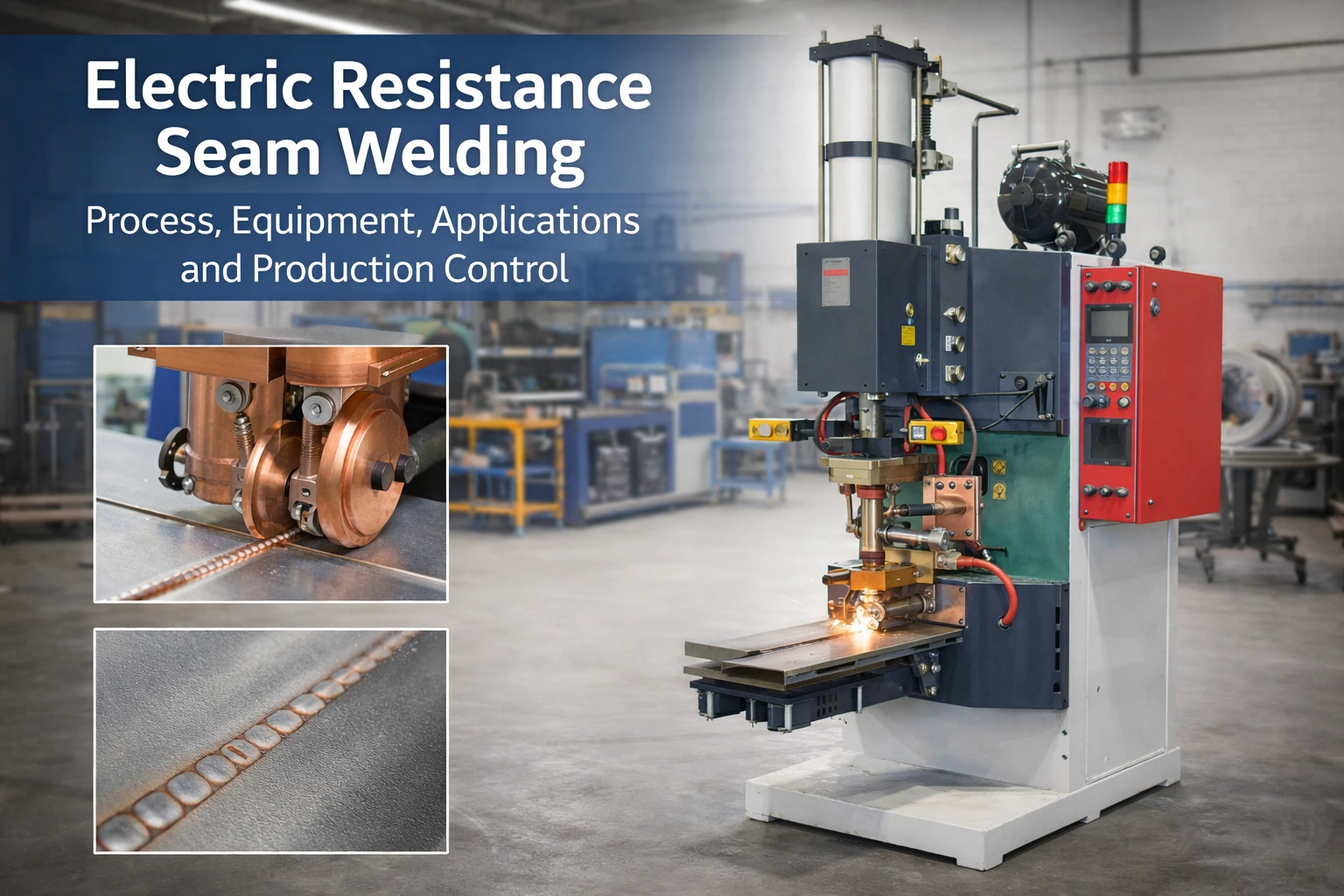
2. Seam Welding
Seam welding uses rotating electrodes to produce a continuous weld along a seam.
Applications:
- Fuel tanks
- Pipes and tubes
- Sealed containers
3. Projection Welding
Projection welding concentrates heat on pre-designed raised points (projections) on the workpiece.
Applications:
- Fasteners
- Nuts and bolts welding
- Electrical components
4. Capacitor Discharge Welding
This method releases stored electrical energy in a very short burst for precision welding.
Applications:
- Electronics
- Thin sheet metals
- Precision assemblies
5. MFDC Welding (Medium Frequency Direct Current)
MFDC is a modern resistance welding method that improves energy efficiency and control accuracy.
Applications:
- Automotive manufacturing
- High-strength steel welding
- Automated production lines
Industrial Applications of Electric Resistance Welding
Electric resistance welding is widely used across multiple industries due to its efficiency and scalability.
Automotive Industry
ERW is essential in automotive body construction, where thousands of spot welds are used in a single vehicle frame.
Electrical and Electronics Manufacturing
Used for joining conductors, terminals, and delicate components with high precision.
Aerospace Industry
Ensures lightweight yet strong joints in aircraft structures and components.
Appliance Manufacturing
Used in refrigerators, washing machines, and HVAC systems.
Construction and Infrastructure
Applied in structural steel components and reinforcement assemblies.
Advantages and Limitations of Electric Resistance Welding
Advantages
- No filler material required
- High production speed
- Clean and consistent welds
- Easy automation integration
- Cost-effective for mass production
- Minimal operator skill required after setup
Limitations
- Limited to conductive metals
- High initial equipment cost
- Not suitable for very thick materials
- Requires precise control of parameters
Despite these limitations, ERW remains one of the most efficient joining methods in industrial manufacturing.
Electric Resistance Welding vs Other Welding Methods
ERW vs MIG Welding
- ERW is faster and more automated
- MIG is more flexible for varied thicknesses
- ERW produces cleaner joints without filler material
ERW vs TIG Welding
- TIG provides higher precision but is slower
- ERW is ideal for mass production
- TIG requires skilled operators, ERW is automation-friendly
ERW vs Laser Welding
- Laser welding offers deeper penetration and flexibility
- ERW is more cost-effective for repetitive production
- ERW systems are easier to maintain in heavy industry
Best Practices for Efficient Resistance Welding
To achieve optimal results in electric resistance welding, manufacturers should follow key engineering practices:
Proper Electrode Maintenance
Electrodes must be cleaned and replaced regularly to maintain consistent conductivity and weld quality.
Accurate Parameter Control
Current, force, and time settings must be precisely calibrated for each material type.
Material Preparation
Surfaces should be clean and free of oxides or contaminants to ensure proper bonding.
Automation Integration
Modern factories benefit significantly from robotic welding arms and CNC-controlled resistance welding systems.
Monitoring and Quality Control
Real-time monitoring systems help detect inconsistencies and reduce defect rates.
Heron Welder: Advanced Solutions for ERW Automation
Modern manufacturing demands precision, scalability, and reliability. Heron Welder delivers advanced resistance welding systems designed for high-performance industrial environments.
Their product portfolio includes:
- Spot welding machines
- Projection welding systems
- Seam welding solutions
- MFDC welding equipment
- Capacitor discharge welding units
- Automated welding production lines
- Welding guns and controllers
By integrating smart control systems and automation-ready designs, Heron Welder helps manufacturers achieve:
- Higher production efficiency
- Reduced cycle times
- Improved weld consistency
- Lower operational costs
- Scalable factory automation
For OEMs and industrial integrators, these systems provide a strong foundation for building modern smart factories.
FAQs about Electric Resistance Welding
1. What metals can be welded using electric resistance welding?
ERW is commonly used for steel, stainless steel, aluminum alloys, and other conductive metals.
2. Is electric resistance welding suitable for automation?
Yes, ERW is highly compatible with robotic systems and automated production lines, making it ideal for high-volume manufacturing.
3. What industries use electric resistance welding the most?
The automotive, appliance, aerospace, and electronics industries are the primary users of ERW technology.
4. What is the main advantage of ERW over traditional welding?
The main advantage is its speed and consistency, especially in mass production environments, with minimal need for consumables.
5. How does electrode wear affect weld quality?
Worn electrodes reduce conductivity and pressure consistency, leading to weaker or inconsistent welds. Regular maintenance is essential.
Conclusion
Electric resistance welding continues to be a critical technology in modern industrial manufacturing. Its ability to deliver fast, clean, and repeatable welds makes it indispensable for high-volume production environments. With increasing demand for automation and precision, ERW systems are evolving into highly intelligent, digitally controlled solutions.
Manufacturers seeking to improve efficiency, reduce costs, and scale production can benefit significantly from advanced resistance welding systems offered by Heron Welder.
Call to Action
If you are looking to upgrade your production line with advanced electric resistance welding solutions, consider partnering with an expert in industrial welding automation. Contact Heron Welder to explore customized welding systems, automation integration, and high-performance equipment designed for modern manufacturing needs.