Engine oil isn’t just a lubricant. It’s the circulatory system of your Cadillac — carrying away heat, preventing friction, protecting metal surfaces, and directly influencing both how your car performs and how far it travels on a gallon. When you neglect it, everything suffers. Understanding the critical relationship between clean oil and engine efficiency is the first step toward owning a Cadillac that runs like new for years to come. This is why regular Cadillac oil change in Dubai isn’t an optional service—it’s fundamental maintenance.
Most Cadillac owners know they need an oil change periodically. What many don’t fully grasp is just how much their engine’s performance and fuel consumption depend on the condition of that oil. A Cadillac with clean, properly-specified oil delivers smoother acceleration, more stable idle, better throttle response, and measurably better fuel economy. A Cadillac running on degraded or incorrect oil experiences power loss, reduced MPG, and accelerated internal wear.
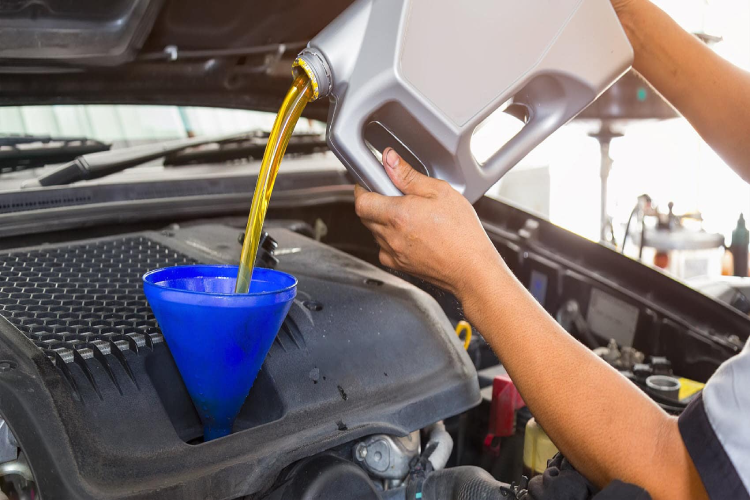
How Engine Oil Impacts Cadillac Performance
Performance in a Cadillac context means smooth, responsive, and efficient power delivery. Clean engine oil is essential to this equation. Here’s why:
Friction Reduction: Engine oil creates a protective film between moving metal surfaces — pistons, rings, bearings, camshafts. When oil is fresh and at the correct viscosity, this film is optimal. The engine turns over easily, combustion is more complete, and power transfers to the wheels without unnecessary energy loss to internal friction.
As oil ages, it thickens and loses its protective properties. Internal friction increases. Your engine has to work harder just to turn itself over. You notice it as sluggish acceleration, delayed throttle response, and a general feeling that the car isn’t pulling like it used to.
Temperature Regulation: Oil absorbs heat from the engine’s combustion process and carries it to the cooler, where it’s dissipated. If oil is dirty or contaminated, it becomes less efficient at this heat transfer. The engine runs hotter than designed. Higher temperatures increase emissions, reduce fuel efficiency, and accelerate wear on seals and gaskets.
Deposit Prevention: Modern Cadillac engines are precisely engineered. Fuel injectors, valve seats, and piston rings are designed to tight tolerances. Dirty oil allows carbon and sludge deposits to accumulate in these areas, degrading performance incrementally. A valve seat clogged with deposits doesn’t seal properly. A fuel injector fouled with varnish doesn’t spray the optimal mist. Both steal power and efficiency.
⚡
Better Acceleration
Clean oil reduces internal friction, delivering quicker throttle response
🔧
Smoother Idle
Lower friction means steadier combustion and more stable RPM
🌡️
Cooler Running
Proper oil temperature management prevents overheating
💪
More Power
Less parasitic loss means more power reaches the drivetrain
Engine Oil and Fuel Efficiency: The Direct Connection
Fuel economy in a Cadillac is directly tied to how freely the engine can turn. Every bit of internal friction is energy wasted on turning the engine itself rather than moving the car forward. This is called “parasitic loss.”
A properly maintained Cadillac with fresh oil exhibits lower parasitic loss. The engine turns over easily. Compression is efficient. Combustion is complete. Fuel burns at the designed temperature and pressure. The result: better miles per gallon.
Studies consistently show that an engine running on dirty oil can experience 1-3% reduction in fuel economy. On a Cadillac that averages 25 MPG, that’s the difference between 25 and 24.3 MPG — not massive on one tank, but over a year of driving, it adds up to noticeable wasted fuel and money.
Clean Oil (Fresh Change)
Optimal friction levels, efficient heat transfer, clean fuel injectors, stable combustion — engine delivers designed fuel economy.
Dirty Oil (Overdue Change)
Increased friction, reduced heat transfer, deposit buildup, inconsistent combustion — fuel economy drops measurably.
More importantly, running on degraded oil accelerates engine wear. Microscopic metal particles circulate in old oil, scoring cylinder walls and bearing surfaces. Over time, this wear widens tolerances. Compression drops. Oil consumption increases. The downward spiral continues until major engine work becomes necessary.
Important Note
For Cadillac owners in Dubai, the hot climate accelerates oil degradation. Higher ambient temperatures, frequent heavy traffic, and highway driving cause oil to break down faster than in cooler climates. Many experts recommend shortening your Cadillac oil change service in Dubai intervals by 500-1,000 miles compared to standard recommendations.

Choosing the Right Oil for Your Cadillac
Not all oils are created equal. Cadillac specifies certain oil viscosities and performance standards for each engine. Using the wrong oil — either too thick or too thin, or lacking required additives — compromises both performance and protection.
Most modern Cadillacs call for synthetic or synthetic-blend oil meeting GM Dexos specifications. Synthetic oil:
Lasts longer (up to 10,000 miles)
Flows better at low temperatures
Resists breakdown at high heat
Provides better protection
Improves fuel economy slightly
Conventional oil is cheaper but requires more frequent changes. For a luxury vehicle like Cadillac, where performance matters and engines are precision-tuned, synthetic or synthetic-blend is the right choice.
The Importance of Regular Service
The question isn’t whether to get a Cadillac oil change workshop in Dubai — it’s when, and where. Most Cadillacs running synthetic oil can go 7,500 to 10,000 miles between changes. Some newer models with advanced oil-life monitoring systems can stretch to 12,000 miles. Always follow the guidance in your owner’s manual or your car’s built-in service reminder.
Finding the right service center matters. A proper oil change isn’t just draining old oil and pouring in new. It includes:
Replacing the oil filter with the correct OEM or equivalent part. Inspecting fluid levels and tops-offs (coolant, brake fluid, transmission). Checking belt condition and hose integrity. Resetting service indicators. For Cadillacs, all of this should be done by technicians familiar with GM specifications and your car’s specific requirements.
When you search for Cadillac oil change at best price in Dubai, don’t choose based on cost alone. An oil change at a reputable Cadillac specialist or authorized service center costs slightly more but guarantees proper fluids, correct procedures, and documentation that protects your warranty and resale value.
Frequently Asked Questions
How often should I change the oil in my Cadillac? Does it depend on driving conditions?
Most newer Cadillacs on synthetic oil can go 7,500 to 10,000 miles between changes — some up to 12,000 miles. Check your owner’s manual or the service reminder on your dashboard. That said, driving conditions matter. If you do a lot of short trips, towing, or driving in heavy traffic (like Dubai), oil degrades faster and you might benefit from changing at the lower interval. If you drive mostly highway at consistent speeds, you can stretch toward the upper limit. In Dubai’s heat, many owners choose to change every 5,000-7,500 miles as a precaution, even if their manual allows longer. Better to be cautious with a precision engine like Cadillac’s.
Can I use a cheaper generic oil in my Cadillac instead of the recommended synthetic?
Technically, you can — but you shouldn’t. Cadillac engines are designed and tested with specific oil specifications (usually GM Dexos synthetic or equivalent). Using a cheaper conventional oil or a non-approved synthetic exposes your engine to several risks: you’ll need more frequent changes (every 3,000-5,000 miles instead of 10,000), the engine may run slightly hotter, deposits may accumulate faster, and your warranty could be affected if the oil doesn’t meet GM specs. The cost difference between synthetic and conventional over a year is roughly $30-50. It’s insurance for an engine that costs tens of thousands of dollars to rebuild. Not worth the gamble.
Does an oil change really improve fuel economy, or is that just marketing hype?
It’s real, not marketing. Studies show 1-3% fuel economy improvement after an oil change, especially if the previous oil was overdue or low. The mechanism is simple: dirty oil has higher viscosity and creates more internal friction. Your engine has to work harder just to turn itself over. Fresh oil is thinner and slicker, so less energy is wasted. Over 10,000 miles at 25 MPG, a 2% gain saves roughly one tank of fuel — not massive, but measurable. On a Cadillac especially, with a larger engine, the gains tend to be on the higher end. Plus, you’re also improving performance and engine longevity, so the benefits extend beyond just MPG.
Is it safe to drive in Dubai heat with the recommended oil, or should I use a heavier grade?
Use the viscosity grade your owner’s manual specifies — don’t second-guess it. Modern Cadillacs are engineered with specific oil viscosity in mind, and modern synthetic oils are formulated to maintain their properties across wide temperature ranges. A 5W-30 synthetic is designed to flow properly at cold starts (the 5W part) and still maintain proper film strength at high temperatures (the 30 part). Using a heavier grade like 10W-40 in Dubai heat doesn’t add protection — it actually increases fuel consumption and can impair engine startup on cooler mornings. What matters more in Dubai is that you use a high-quality synthetic with good thermal stability, change it on schedule, and keep your cooling system in top condition. Trust the engineers who designed your Cadillac.
Thanks, www.glycol.com