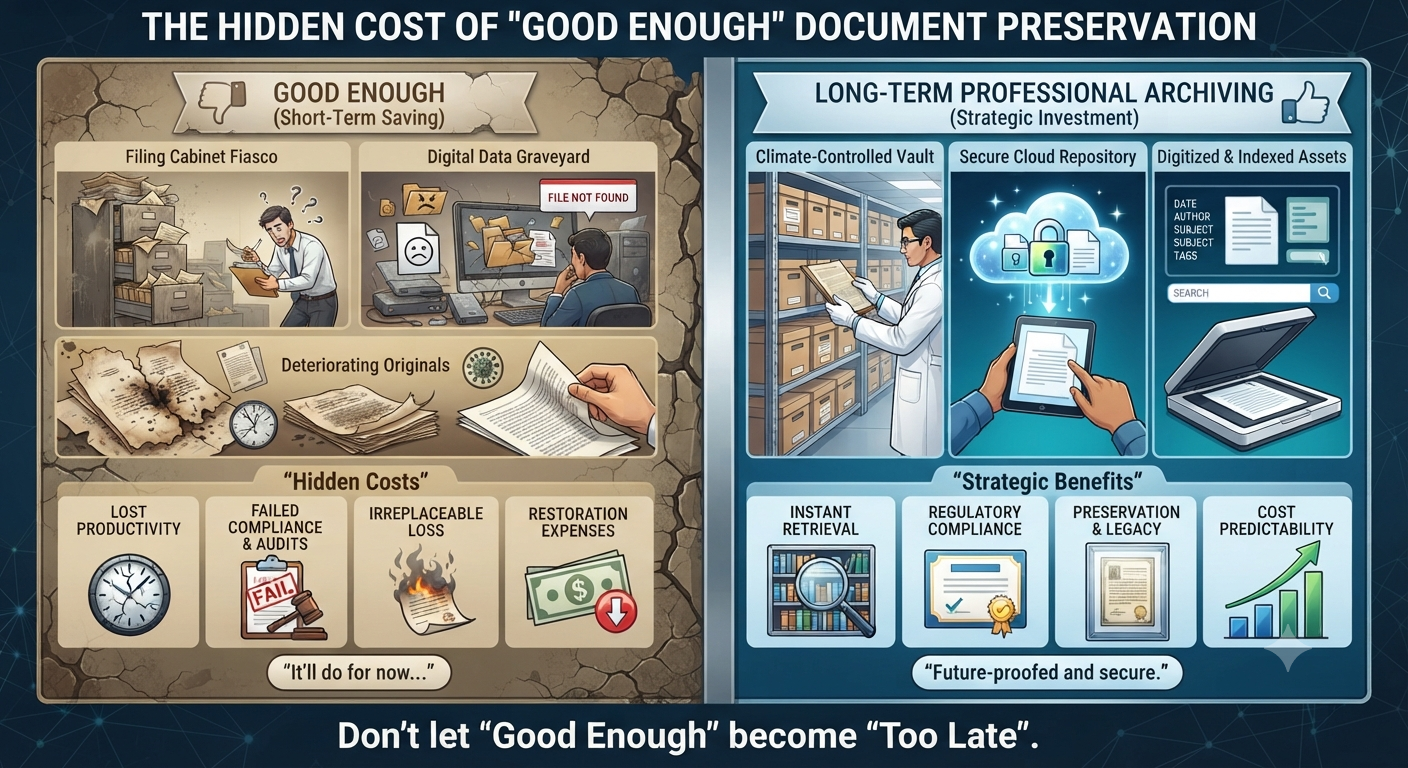
Most businesses assume their documents are safe once they’re signed, sealed, and stored. That assumption breaks down the moment a certificate expires or a court asks for proof that a document is exactly what it claims to be. Qualified preservation services exist to close that gap, and skipping them costs more than most companies realize, usually not until the moment they need the proof most.
This isn’t a theoretical risk. Every organization that relies on electronic signatures for contracts, approvals, or regulatory filings is quietly building a stack of documents whose legal defensibility decays with time. Understanding why, and what qualified preservation actually does about it, is the difference between a document that holds up in a dispute and one that doesn’t.
1. What Qualified Preservation Services Actually Do
Qualified preservation services keep qualified electronic signatures and seals legally verifiable long after their original technical validity period ends. Under Article 34 and Article 40 of eIDAS Regulation (EU) No. 910/2014, a qualified trust service provider (QTSP) maintains the evidence chain behind a signed document, including certificate status, timestamps, and validation data, so the document still holds up years or even decades later.
This is not the same as simply keeping a file in storage. A stored file just sits there. A qualified preservation service actively works in the background: monitoring certificate lifecycles, renewing cryptographic evidence, and applying qualified timestamps before the existing proof becomes unreliable. It is a continuous process, not a one-time archiving action.
The distinction matters because a signature’s validity is not permanent by default. Left alone, the technical proof behind it degrades. Qualified preservation is the mechanism that stops that degradation from becoming a legal liability.
2. Why “Good Enough” Storage Fails Over Time
Standard backups answer one question: does the file still exist? They don’t answer whether the signature on it can still be trusted, which is a very different problem. Three things quietly erode that trust over the life of a document:
- Certificates expire. Every qualified certificate has a validity window. Once it lapses, verifying the signature without preserved evidence becomes difficult or, in some cases, impossible.
- Cryptographic algorithms weaken. What was considered secure in 2015 may be considered breakable by 2035. As computing power grows, older algorithms become vulnerable, which retroactively undermines the strength of signatures created under them.
- Formats become obsolete. A file readable today may not open correctly in a system built ten or twenty years from now, especially as software vendors deprecate old standards.
None of these failures are visible on day one. A signed contract looks exactly as valid the day after signing as it does five years later, right up until someone tries to verify it and finds the trust chain broken. That moment tends to arrive during an audit, a legal dispute, or a regulatory inspection, which is exactly when the document’s validity matters most and exactly when it’s too late to fix retroactively.
3. How Qualified Preservation Differs From Standard Preservation
Standard preservation keeps a file accessible. Qualified preservation keeps a signature legally defensible. The distinction comes down to a few specific gaps between the two approaches:
- Legal basis. Standard preservation has no specific eIDAS mandate behind it. It’s a general-purpose storage practice. Qualified preservation is governed directly by Article 34 for signatures and Article 40 for seals, with a defined regulatory framework behind it.
- What’s actually protected. Standard preservation protects file existence and readability. Qualified preservation protects the long-term validity of the signature or seal itself, which is a separate and more demanding requirement.
- Certificate expiry handling. Standard preservation doesn’t address certificate expiry at all. Qualified preservation renews evidence proactively before expiry becomes a problem, keeping the trust chain unbroken.
- Provider accountability. Standard preservation can be handled informally by any storage vendor, cloud provider, or internal IT team. Qualified preservation must come from an accredited QTSP operating under eIDAS supervision and audit.
- Evidentiary strength over time. Standard preservation weakens as certificates and algorithms age, even if the file itself is untouched. Qualified preservation maintains an unbroken, verifiable trust chain throughout the entire retention period.
Businesses that conflate the two often discover the difference only when a document’s validity is actually challenged, which is the worst possible time to learn that “preserved” and “qualified” are not the same thing.
4. Who Actually Needs This
Qualified preservation matters most for organizations that rely on signed or sealed records as legal or regulatory evidence, not just as internal documentation. That includes:
- Financial services managing contracts, loan agreements, and compliance filings that may need to be produced years after signing.
- Healthcare providers retaining signed consent forms and clinical records, often for periods mandated by law that stretch well beyond a decade.
- Legal and public sector bodies handling documents that may be contested in court or reviewed under freedom-of-information requests.
- Pharma and life sciences companies operating under GxP and other audit-heavy regulatory regimes where evidentiary gaps trigger compliance findings.
- Any business operating cross-border in the EU, where document validity must hold up consistently across different jurisdictions and legal systems.
If a signed document could ever end up in front of a regulator, auditor, or judge, its long-term validity is not optional. It’s part of the cost of doing business in a regulated environment.
5. The Real Cost of Skipping It
The cost of “good enough” preservation rarely shows up on a balance sheet in any obvious way. Instead, it shows up as:
- A contract that can’t be enforced because the signature can no longer be validated, undermining the organization’s position in a dispute.
- An audit found that flags missing evidence of document integrity, creating compliance exposure that didn’t need to exist.
- A regulatory inspection that stalls because records can’t prove their own authenticity, delaying approvals or triggering penalties.
- Legal exposure in disputes where the other side challenges the document’s validity, and there’s no evidence chain available to defend it.
Each of these outcomes traces back to the same root cause: evidence that should have been renewed years earlier wasn’t, because nobody was actively managing it. By the time the gap becomes visible, reconstructing that evidence after the fact is rarely possible.
6. What a Qualified Preservation Provider Must Guarantee
Before choosing a provider, confirm they deliver on these non-negotiable points:
- Accreditation as a QTSP listed on the EU Trusted List, not just a vendor claiming eIDAS compliance in marketing copy.
- Proactive evidence renewal ahead of certificate and algorithm expiry, following recognized standards such as ETSI TS 119 511.
- Qualified timestamps from accredited sources, anchoring the document’s validity to a specific, provable point in time.
- An unbroken audit trail covering every renewal, validation, and access event across the document’s lifecycle.
- No alteration of the original signed record at any point during the preservation process.
Providers that can’t clearly explain how they handle certificate expiry or evidence renewal aren’t offering qualified preservation, whatever language appears on their website.
Conclusion
The businesses that get burned by this aren’t cutting corners deliberately. They simply never checked whether their preservation setup was qualified or just convenient, and the two look identical until a document’s validity is actually tested. Reviewing that distinction now, before a contract lands in a dispute or an auditor asks for proof, costs far less than trying to reconstruct evidence after the trust chain has already broken. Qualified preservation isn’t an added layer of compliance overhead. It’s what keeps a signed document worth the paper it was never printed on.