
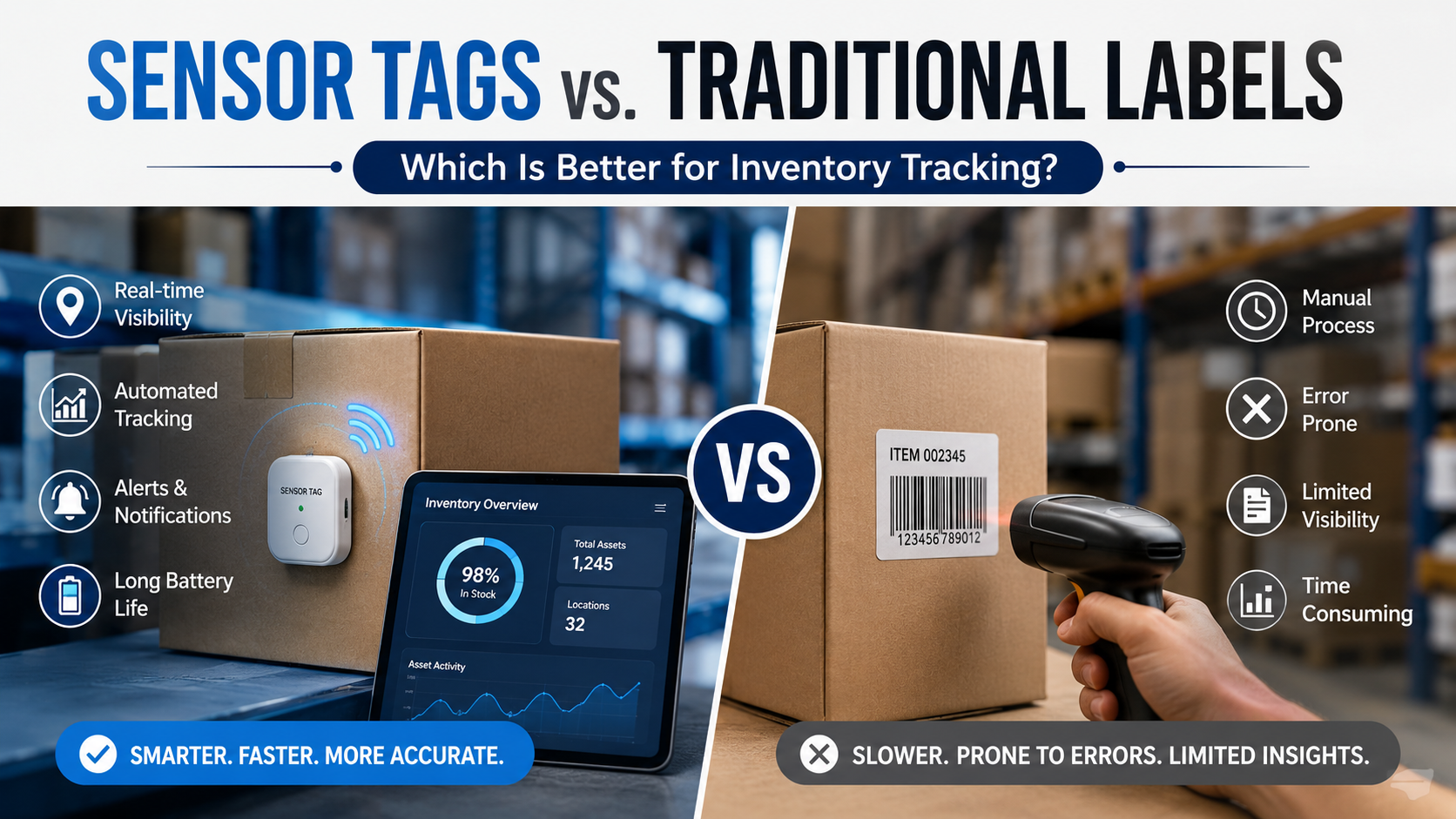
Inventory tracking can look simple until a business manages thousands of products across warehouses, stores, production floors, or distribution centers. A traditional label may identify an item, but identification alone does not always provide enough information to keep inventory accurate. This is where sensor tags can offer a more capable approach by supporting automated identification and, depending on the technology, additional data collection.
The choice between sensor tags and traditional labels depends on inventory volume, tracking requirements, operating conditions, and budget. A small business with a few hundred products may not need advanced tracking technology. However, companies handling high-value assets, frequent stock movements, or time-sensitive products may benefit from more automated solutions.
What Are Sensor Tags and Traditional Labels?
Traditional labels are printed identification markers attached to products, containers, shelves, or assets. They commonly include product names, SKUs, barcodes, QR codes, serial numbers, or other information. Employees typically scan or visually inspect these labels during receiving, picking, counting, and shipping.
Sensor tags take inventory identification a step further. Depending on the system, they may use RFID, NFC, Bluetooth, or other sensing technologies to communicate information electronically. Some solutions can also capture conditions such as temperature, humidity, location, or movement.
The important distinction is automation. A printed label generally requires a person or scanner to read it. A sensor-based system can potentially collect information with much less manual intervention.
Sensor Tags vs. Traditional Labels: Key Differences
The best option becomes clearer when comparing how each technology performs during everyday inventory operations.
Identification and Data Collection
Traditional labels are straightforward. A barcode scanner reads the printed code, and the inventory system records the transaction. QR codes can hold more information and work well with smartphones and mobile devices.
Sensor tags can provide more automated identification. RFID, for example, can allow multiple tagged items to be identified without scanning each barcode individually. This can save substantial time during inventory counts.
Consider a warehouse receiving 500 cartons. With traditional barcodes, an employee may need to position and scan each carton. With an appropriate RFID setup, multiple cartons could potentially be read in a single pass.
Speed and Labor Requirements
Manual scanning creates additional labor requirements. Employees must locate labels, position scanners, and confirm that every item has been processed.
Sensor-based systems can reduce these repetitive steps. The productivity improvement becomes particularly valuable when inventory moves frequently.
However, automation does not eliminate labor completely. Tags still need to be applied correctly, readers require configuration, and inventory software must process the collected data.
Accuracy
Traditional labels can provide excellent accuracy when employees scan them correctly. Problems often occur because labels become damaged, misplaced, duplicated, or skipped during manual processes.
Sensor tags can reduce some human errors by automating identification. Yet they introduce their own technical considerations. Radio interference, metal surfaces, liquids, tag placement, and reader configuration can affect certain RFID systems.
Therefore, sensor technology is not automatically more accurate in every environment. Proper implementation matters.
Cost
Traditional labels generally have a lower upfront cost. Printing labels, purchasing scanners, and maintaining basic inventory software can be relatively affordable.
Sensor tags usually require a larger investment. Costs can include tags, readers, antennas, gateways, software, installation, and integration.
The right comparison should therefore focus on total operating cost rather than tag price alone. A more expensive system can make financial sense if it saves hundreds of employee hours each month.
How to Choose the Right Inventory Tracking Method
Businesses should evaluate their requirements before replacing an existing labeling system.
Step 1: Measure Inventory Complexity
Start by documenting how many products or assets you track and how frequently they move.
A small retailer with 1,000 stable SKUs may find barcode labels completely adequate. A distribution center processing tens of thousands of items daily has a stronger reason to investigate automation.
Step 2: Identify the Biggest Bottleneck
Do not adopt new technology simply because it is newer.
Ask where inventory problems actually occur. Are employees spending hours performing stock counts? Are shipments frequently missing items? Are high-value assets difficult to locate? Is temperature monitoring necessary?
The answer can determine whether advanced tagging provides meaningful value.
Step 3: Consider the Operating Environment
Evaluate storage conditions before selecting a technology.
Cold storage, outdoor facilities, manufacturing areas, metal shelving, and high-humidity environments can influence tag durability and electronic performance. A tag designed for a retail shelf may not be suitable for an industrial facility.
Step 4: Calculate Return on Investment
Compare the technology’s total cost with measurable savings.
For example, suppose a warehouse spends 400 labor hours each month on manual inventory counts. If automated identification cuts that workload substantially, the labor savings may justify the additional equipment.
Also consider reduced stockouts, fewer shipping errors, improved asset utilization, and better inventory visibility.
Common Mistakes When Choosing Inventory Tags
One common mistake is assuming that advanced technology automatically means better inventory management. Technology only works when it solves a real operational problem.
Another mistake is focusing exclusively on tag costs. A cheap label that requires significant manual labor may cost more over its useful life than a higher-priced automated solution.
Businesses also sometimes overlook integration. Inventory tags need to work with warehouse management systems, enterprise resource planning software, point-of-sale platforms, or other systems already in use.
Testing is equally important. Before deploying thousands of tags, conduct a pilot in the actual environment. Test different products, shelving configurations, distances, and workflows.
Practical Tips for Better Inventory Tracking
Start with a clear inventory process before selecting technology. Document receiving, storage, picking, counting, transfers, and shipping. This reveals exactly where identification problems occur.
Use traditional labels where simplicity is valuable. Barcodes and QR codes remain practical for many businesses because they are inexpensive, familiar, and easy to replace.
Use sensor technology where automation creates measurable benefits. High-volume warehouses, equipment tracking, supply chains, and condition-sensitive products can be strong candidates.
Standardize your identification system as much as possible. Consistent SKU structures, naming conventions, tag placement, and scanning procedures make inventory data easier to maintain.
Finally, train employees properly. Even highly automated systems can produce unreliable inventory records when workers bypass procedures or incorrectly handle tagged products.
Which Option Is Better?
There is no universal winner between sensor tags and traditional labels.
Traditional labels are usually better when affordability, simplicity, and straightforward identification are the main priorities. They work especially well for small and medium-sized operations with manageable inventory volumes.
Sensor tags become more attractive when a business needs faster counting, automated identification, location visibility, or environmental monitoring. Their higher implementation cost can be justified when inventory complexity creates significant labor or accuracy problems.
The smartest approach is often a hybrid one. A company might use barcodes for ordinary products while using RFID or sensing technology for high-value assets, pallets, or products requiring additional monitoring.
Conclusion
Choosing between sensor tags and traditional labels should begin with the business problem, not the technology. Traditional labels remain reliable and economical for many inventory environments, while sensor tags can provide greater automation and visibility when operations become more complex.
Evaluate inventory volume, labor requirements, accuracy issues, environmental conditions, software integration, and total cost before deciding. A small pilot can then confirm whether the expected benefits appear in real-world operations. The best tracking system is ultimately the one that delivers accurate inventory information without adding unnecessary complexity.