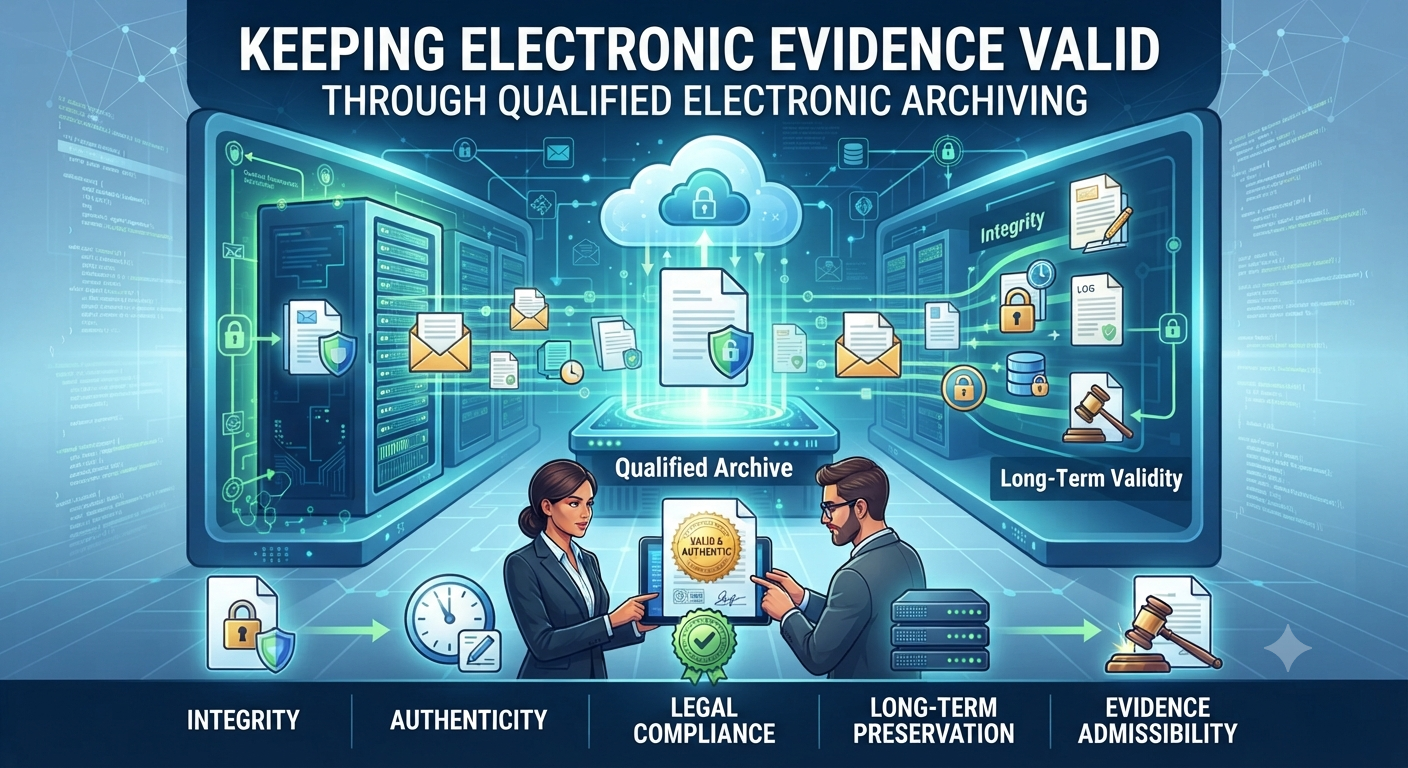
Electronic evidence may need to remain reliable long after the transaction, audit, dispute, or regulatory process that created it. A signed agreement could be reviewed years later, while a financial record may support an investigation after its original system has been replaced. Qualified Electronic Archiving protects this evidence through controls for integrity, origin, durability, legibility, access, and lifecycle governance.
The objective is not to guarantee automatic acceptance in every legal proceeding. It is to establish a stronger evidential position by showing what entered the archive, where it came from, how it was protected, who accessed it, and whether it changed.
Why Electronic Evidence Can Lose Reliability
Digital records are easy to copy, rename, convert, move, and edit. These actions may be legitimate, but they can weaken later verification when they are not controlled or documented.
Evidence becomes harder to defend when:
- The original application has been retired
- Files are separated from their metadata
- Audit trails are incomplete
- Record relationships are lost during migration
- Electronic signatures can no longer be validated
- File formats become difficult to open
- Retention decisions are undocumented
A file may still exist while the organization can no longer explain its origin or history. Qualified Electronic Archiving makes the archive part of the evidence chain instead of treating it as a passive storage location.
What Qualified Electronic Archiving Adds
Standard electronic archiving stores and retrieves records. Long-term digital preservation keeps information readable and usable. Qualified Electronic Archiving adds a regulated trust-service layer for preserving integrity, proof of origin, confidentiality, durability, legibility, and controlled access.
The amended eIDAS framework introduced electronic archiving and qualified electronic archiving as trust-service categories. Electronic data and documents preserved using a qualified service benefit from a legal presumption concerning their integrity and origin. The European Union also adopted detailed reference standards and specifications for qualified electronic archiving services in December 2025.
This does not prove that the statements inside a document are factually correct. It supports confidence that the archived record was preserved under controlled conditions and was not altered without detection.
Controlled Ingestion Establishes the Starting Point
Evidence protection begins when a record enters the archive.
A controlled ingestion process should identify the source system, capture the submission method and time, confirm that required files and metadata are present, and document the condition of the information received.
The process may include:
- Verifying the document or data package
- Identifying formats and technical dependencies
- Detecting electronic signatures or seals
- Capturing provenance and business metadata
- Creating cryptographic integrity values
- Applying access and retention rules
- Recording the ingestion event
If source, ownership, or completeness information is not captured during ingestion, reconstructing it years later may be difficult or impossible.
Integrity, Provenance, and Auditability Support Trust
Cryptographic hashes create digital fingerprints for files and archival packages. The archive can recalculate them during scheduled fixity checks. A mismatch may indicate corruption, loss, or unauthorized modification.
Provenance explains the record’s origin and history. It may identify the source application, submitting organization, original record identifier, ingestion date, and subsequent preservation events.
The audit trail should record significant actions, including:
- Ingestion and validation
- Metadata changes
- Integrity checks
- User access and exports
- Legal hold decisions
- Format migrations
- Retention updates
- Authorized deletion
Together, these controls help establish which system created the record, whether it was complete when archived, whether it changed, which version is authoritative, and how it relates to other evidence. Qualified archiving services are intended to maintain durability, legibility, integrity, confidentiality, and proof of origin throughout the preservation period.
Signed Evidence Requires Additional Preservation
A signed document can remain readable while its electronic signature becomes difficult to validate.
Certificates expire, revocation services change, trust information evolves, and cryptographic algorithms weaken. Qualified preservation services address the signature or seal by retaining validation results, timestamps, certificate information, revocation evidence, and renewed evidence records.
Qualified Electronic Archiving addresses the wider document, its metadata, governance, retention, and access history. The two services can work together when a contract, regulatory submission, or official document must remain both accessible as a business record and verifiable as signed evidence.
Long-Term Accessibility Protects Practical Value
Evidence has little value if authorized users cannot open, search, or understand it.
Qualified archiving requires durability and legibility beyond the normal lifespan of applications and formats. Preservation planning may identify formats at risk, retain original objects, create sustainable representations, validate migrations, and document each transformation.
Metadata supports retrieval through meaningful fields such as:
- Customer or employee name
- Case number
- Contract reference
- Transaction date
- Document category
- Source application
This is particularly important during application retirement. A flat export may preserve individual files while destroying the relationships required to understand the original transaction.
Retention and Legal Holds Prevent Improper Disposal
Evidence should not be retained forever without justification, but it must not be deleted while subject to a legal, contractual, regulatory, or operational requirement.
Retention rules should define:
- Why the record must be kept
- When the retention period begins
- Which events extend the period
- Who can authorize disposal
- How deletion will be documented
Legal holds should suspend normal deletion when records become relevant to disputes, investigations, audits, or regulatory reviews. Each hold should record why it was applied, which records it covered, who authorized it, and when it was released.
A governed archive should therefore support both long-term preservation and defensible disposal. Keeping unnecessary data indefinitely can create privacy, security, and discovery risks.
How Docbyte Supports Qualified Electronic Archiving
Docbyte Vault provides a governed preservation and archive layer for organizations that need more than file storage. It manages archival packages, metadata, integrity evidence, access rights, audit trails, retention schedules, legal holds, and preservation actions throughout the record lifecycle.
The platform can support controlled ingestion from business applications, portals, document repositories, and retired systems. It preserves provenance and record relationships so information remains understandable after the original application is no longer available.
For electronically signed or sealed records, Docbyte can combine Qualified Electronic Archiving with signature preservation. This helps organizations maintain both the wider business record and the technical trust evidence connected with it.
Conclusion
Qualified Electronic Archiving keeps electronic evidence valid by preserving the controls and context needed to evaluate it over time. It protects integrity, origin, provenance, accessibility, audit history, retention status, and the relationships that explain what a record represents.
Its value does not come from placing a file in secure storage. It comes from maintaining a documented evidence chain that can survive certificate expiry, system retirement, format change, staff turnover, audits, disputes, and regulatory review.
Docbyte Vault supports this process through controlled ingestion, preservation packaging, fixity monitoring, governed access, retention management, legal holds, and auditable retrieval. Organizations should begin by identifying records that may need to be defended years from now and assessing whether their current archive can prove where those records came from, whether they changed, and how they were governed.