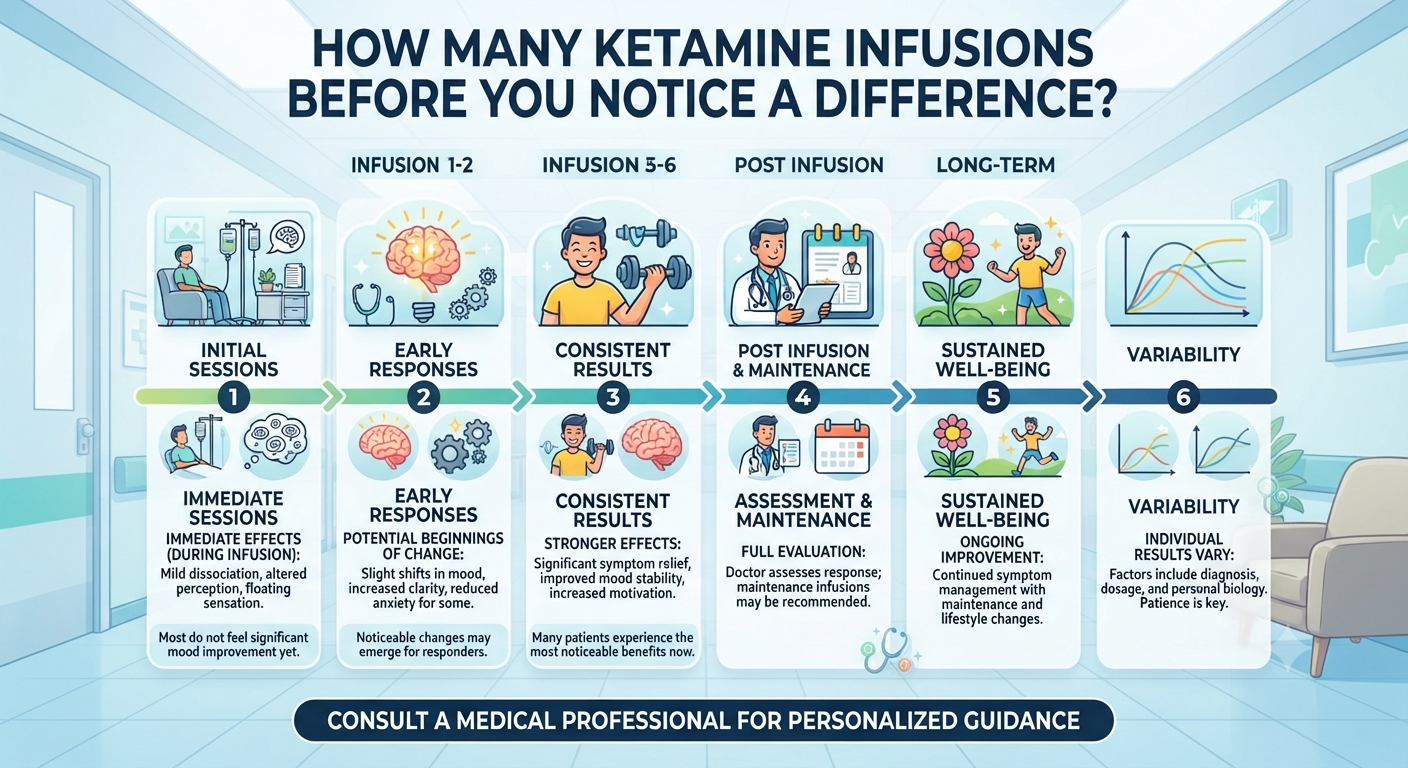
Starting Ketamine Infusion Therapy often comes with one urgent question: how many sessions will it take before anything changes? Some people notice a shift after their first infusion. Others need several treatments before improvement becomes clear. There is no universal number because response depends on the condition being treated, symptom severity, medical history, dosage, and individual biology. Still, clinical research provides a useful timeline for setting realistic expectations.
Can One Ketamine Infusion Make a Difference?
Yes, a single infusion may produce noticeable effects, particularly in people receiving ketamine for treatment-resistant depression. That does not mean every patient will experience dramatic relief after one appointment.
In a randomized controlled trial involving adults with treatment-resistant major depression, researchers compared intravenous ketamine with midazolam, an active control. Twenty-four hours after treatment, 64% of participants who received ketamine met the study’s response criteria, compared with 28% of those who received midazolam. A response meant that depression scores had fallen by at least 50%.
Some people describe early changes as a lighter mood or reduced emotional pressure. Others notice practical improvements first. They may sleep more regularly, respond to messages, complete household tasks, or feel less overwhelmed by routine decisions.
These changes can be subtle. A patient may not suddenly feel happy. Instead, the day may feel slightly more manageable.
One early response also does not guarantee lasting improvement. Research suggests that the antidepressant effect of a single ketamine infusion can be rapid but temporary. Symptoms may begin returning within several days or weeks, which is why clinicians frequently use a series of treatments rather than relying on one session.
Why Several Infusions Are Often Recommended
Many treatment plans begin with an initial series of approximately six infusions delivered over two or three weeks. The exact schedule varies by provider, diagnosis, physical health, and response.
Research indicates that improvement may build across repeated sessions. In a study examining single, repeated, and maintenance ketamine infusions, 59% of participants responded after the repeated-infusion phase and 23% reached remission. Among those who responded, the median number of infusions required to meet the response threshold was three.
That median is useful, but it is not a deadline. It means half of the responders improved by the third infusion, while the other half required more time. It does not mean everyone should expect results after exactly three sessions.
A separate study evaluated six consecutive ketamine infusions in patients who remained on stable antidepressant regimens. Researchers found that response and remission developed progressively during the treatment series, supporting the idea that repeated exposure may strengthen the initial effect.
This is why clinicians generally evaluate the whole induction series rather than declaring treatment unsuccessful after one difficult or uneventful session. A person who feels no change after the first infusion may improve after the third, fourth, or fifth.
However, continuing indefinitely without measurable progress is not sensible. A responsible provider should track symptoms, functioning, side effects, and treatment goals throughout Ketamine Infusion Therapy. If there is no meaningful improvement after the planned initial series, the provider and patient should reassess the diagnosis, dosage, treatment method, and broader care plan.
What Does “Noticing a Difference” Actually Mean?
Improvement does not always arrive as a dramatic emotional breakthrough. Patients and clinicians should look for several types of change.
Emotional symptoms may become less intense. Negative thoughts may feel less repetitive. Feelings of hopelessness may occupy less of the day. Anxiety may become easier to interrupt.
Functional changes can be equally important. A patient might return to work, prepare a meal, exercise, attend therapy, or reconnect with family. These ordinary actions often provide stronger evidence of progress than a temporary feeling during or immediately after an infusion.
Clinicians may use tools such as the Patient Health Questionnaire-9 or the Montgomery-Asberg Depression Rating Scale to measure changes consistently. These assessments can reveal progress that is difficult for the patient to recognize from day to day.
Patients should also separate the experience of the infusion from the treatment outcome. Feeling detached, relaxed, emotional, or visually stimulated during a session does not prove that the therapy is working. Similarly, having a mild session does not mean it failed. The meaningful question is whether symptoms and daily functioning improve over the following hours, days, and weeks.
Safety and Medical Supervision Still Matter
Intravenous ketamine is approved by the U.S. Food and Drug Administration as an anesthetic, but its use for psychiatric conditions is off-label. Off-label treatment is legal, but it requires careful clinical judgment and informed consent.
Ketamine can temporarily increase blood pressure and heart rate. It may also cause nausea, dizziness, sedation, dissociation, or changes in perception. Patients should be monitored during and after an infusion, and they should arrange transportation rather than driving themselves home.
Ketamine is also not appropriate for everyone. A provider should review cardiovascular conditions, substance-use history, pregnancy status, psychiatric diagnoses, and current medications before beginning treatment. The FDA has separately warned about risks associated with compounded ketamine products, particularly when treatment occurs without adequate monitoring.
Conclusion
Some patients notice improvement within 24 hours of their first infusion. Many need approximately three or more sessions before the difference becomes clear. Others complete an initial series without receiving enough benefit to continue.
The most reliable approach is to treat Ketamine Infusion Therapy as a monitored clinical process, not a one-session test or guaranteed cure. Patients should establish specific goals before treatment, track symptoms between appointments, and discuss progress honestly with their provider.
The right question is not only how many infusions it takes. It is whether each session is producing measurable, meaningful improvement in the person’s life.