
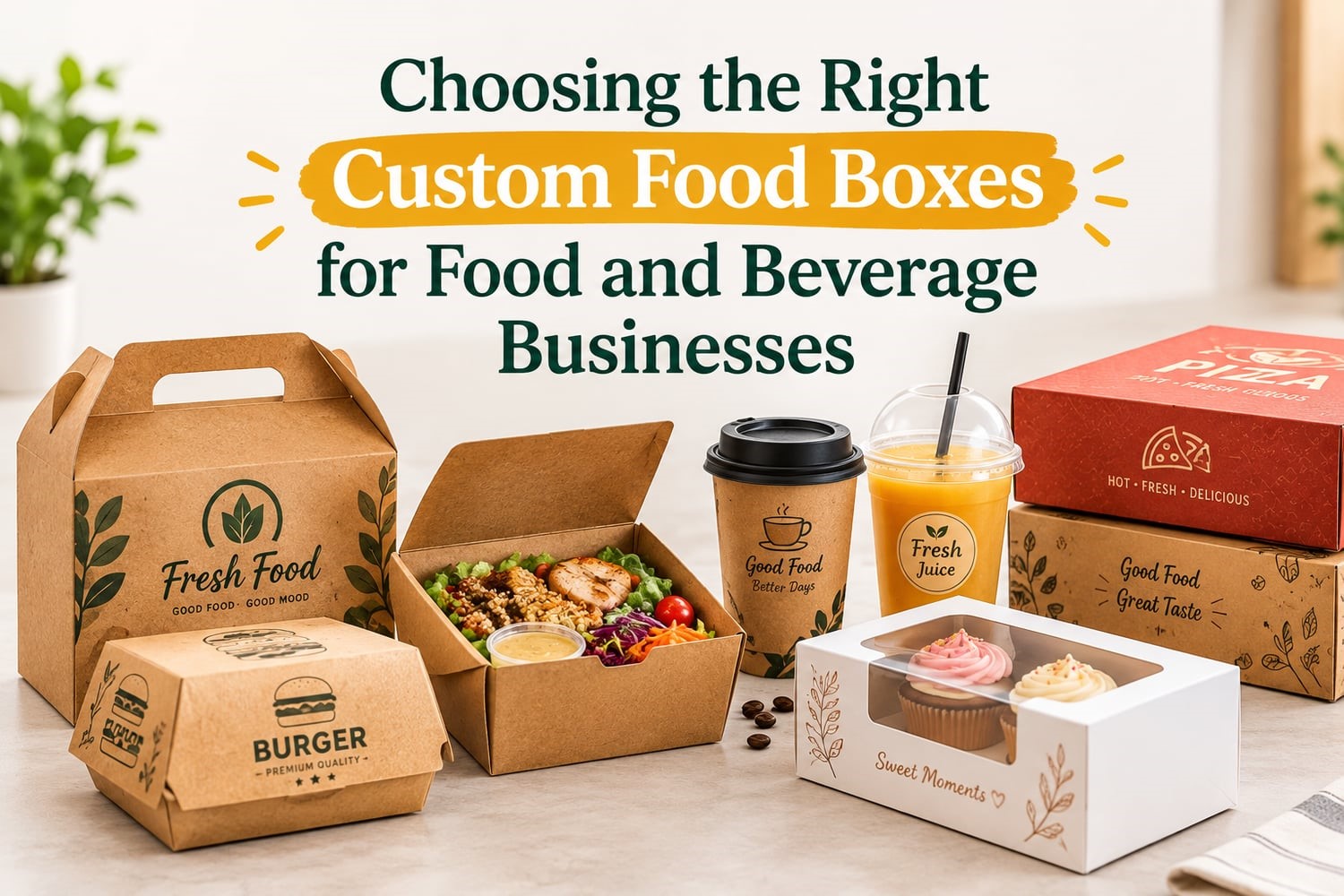
Packaging for food and beverage businesses must serve the purpose of protecting food, provide information on the product being packaged and ensure safe handling by the consumer. Whether it’s for restaurants, bakeries, food manufacturers or takeaway brands, the ideal packaging can help preserve the quality of the food during storage and delivery. Based on the products and the customer, businesses can select the materials, sizes, printing options and designs that suit them best. In many brands the packaging is also a part of the consumer journey, and as such, custom food boxes are a vital business consideration for many brands.
Why Food Packaging Matters for Businesses
There are a number of practical purposes of food packaging. It shields food from dust, moisture, handling, and the elements and facilitates easier transportation. An appropriate food packaging box can also aid businesses to organize products during storage and delivery.
In the case of a takeout, the package must be able to withstand the repeated handling that the food will undergo. Boxes for restaurants can be used for burgers, pizza, sandwiches and other types of meals, and bakeries can use boxes for cupcakes, cookies, cakes, and pastries.
The packaging should be suited to the product, not just the look. A box that is too big can result in an excess of material and product space. If the box is too small, it could break the food when putting it in.
Choosing the Right Box Material
One of the initial decisions that a business must make is with regards to the material that will be used. Many food applications use paperboard or corrugated products as they have varying degrees of strength and flexibility.
Paperboard is suitable for lighter food items, bakery products and retail packaging. For items that demand more protection during the shipment or delivery process, corrugated packaging offers additional protection.
Also, the businesses should check if the packaging should be resistant to grease and moisture or temperature changes. The material needs to be chosen based on the food product, storage conditions, transport method, and the food packaging requirements.
Size and Shape Should Match the Product
The size of the food box should be based on the size of the food. Proper sizing may help to prevent excess material and food loss within a package.
In some instances, boxes need to be tall enough to prevent frosting from touching the top of the box, such as bakery products. Different foods can require separation or different shapes to make take-out meals easier to eat.
In addition to providing businesses with standard box sizes, custom food packaging also enables them to choose the size that fits their products. This can be useful for businesses with unique product shapes and/or multiple product ranges.
Printing Helps Build Brand Recognition
Packaging too is a communication medium. A business can use its box to put its name, logo, product information, contact information, website or social media information.
Custom printed food packaging puts brands in control of these details. The uniformity of packaging for different products can also help customers to identify a brand.
For small food operations, a simple branding may suffice. A simple logo, business name, product information and contact details can give useful information without adding to the complexity of the packaging.
Custom Food Boxes With Logo for Brand Identity
One of the most recognisable features of a food brand is a logo. It can be incorporated into packaging to standardize takeout orders, retail packaging and delivery.
The food boxes are produced in various sizes and style according to the product, and can be customized with the logo of the company. A bakery can have logo printed boxes for cakes, cupcakes, and more, and a restaurant can have branded boxes for takeout.
Consistent branding with the same logo and basic brand information on the packaging, menus, labels and other marketing materials can produce a consistent brand presentation.
Personalized Food Boxes for Different Products
The packaging requirements are not identical for all food products. Personalized food boxes enable businesses to customize them by size, shape, print and finish depending on the products.
For instance, a cookie company could require small boxes, and a meal-prep enterprise could require bigger packing. If there are multiple sizes of cakes sold at a bakery, there can also be multiple dimensions of boxes.
With the personalized food boxes, businesses can then design packaging solutions that are suited to their specific products rather than opting for a single model for all.
We Print Boxes for Different Food Businesses
We Print Boxes offers businesses the option of exploring packaging options based on the packaging requirements of the products they are printing. Whether you are looking for Custom Boxes for your food product or Custom Packaging for specific dimensions, businesses have a choice of packaging to choose from.
Another option for brands that wish to infuse their branding into their packaging is Custom Boxes with Logo. Custom Boxes Wholesale can offer a solution for businesses with frequent packaging needs by offering wholesale packaging supplies.
Firstly the aim should be to choose packaging that is suitable for the product, fits the business budget and is good for brand consistency.
Custom Food Packaging Boxes With Logo
The businesses that wish to have a better brand recognition can combine the practical packaging with the printed brand. The company name, logo, product description, website, social media links or any other related information may be added to custom food packaging boxes with logo.
But packaging should be easy to understand. A box may be difficult to read if there is too much information. Having essential information prominent in a simple format may be more beneficial to customers.
Packaging can also be a way for food businesses to convey limited product information for their products, where the food business sells through stores or delivery platforms, without using all the marketing materials.
Buying Wholesale Food Boxes
Wholesale food boxes might be the choice for companies that have a standard packaging need. Purchasing larger quantities can help ensure uniformity of packaging across multiple orders and decrease the re-ordering of smaller quantities often.
It is important for businesses to verify the box size, material, printing needs, quantity, and delivery time before making a wholesale purchase.
You can also test a sample before ordering in bulk. A sample can be used to verify that the box is an appropriate fit for the product and that the material offers the level of protection needed.
Consider Storage and Transportation
Packaging should not be the end of the product development process. Businesses should also think about how the boxes will be stored prior to use, and how packed products will be transported.
Boxes should be conveniently stacked and stored without wasting any space. Packaging must also be stable when being transported for delivery companies.
Packaging design can be planned to make the packing process faster and less subject to handling problems. This is particularly crucial if your business tends to take a lot of food orders daily.
Sustainability and Material Choices
The materials used for food packaging are also a hot topic for many food businesses. Where deemed suitable, paper-based packaging can be considered but it is advisable for companies to assess what their product requires.
The most appropriate packaging will vary depending on the product and its shelf life, moisture content, type of travel and regional packaging needs.
Instead of “green” packaging because it is sold as such, companies should evaluate the role of the package, and determine if the material is appropriate for the package’s food use.
How to Select the Right Food Boxes
Businesses can follow a simple process when selecting packaging:
- Identify the food product and its dimensions.
- Determine the required material and strength.
- Decide whether the box needs special resistance to moisture or grease.
- Select the appropriate box size and shape.
- Add necessary branding and product information.
- Order a sample before placing a large quantity order.
- Check packaging performance during storage and delivery.
- Choose an order quantity that matches expected demand.
This process can help reduce packaging mistakes and make purchasing decisions more practical.
Final Thoughts
The right packaging should serve to protect the food, facilitate transport, offer information about the product and include a consistent representation of the business. For companies needing to simply print their logos on packaging, have a smaller amount of boxes made, or require larger quantities, the choice should depend on the requirements of the product and operation.
Custom food packaging allows businesses to be more in control of their box sizes, material, printing, and branding. Businesses can create packaging solutions to match their products and customer needs with features like custom printed food packaging, custom food boxes with logo, personalized food boxes, and wholesale food boxes.
FAQs
What are custom food boxes?
Custom food boxes are packaging boxes designed according to a business’s required size, shape, material, and branding.
Can food boxes include a business logo?
Yes. Businesses can use custom food packaging boxes with logo to display their brand name and visual identity.
Are wholesale food boxes suitable for restaurants?
Yes. Wholesale food boxes can be useful for restaurants and other businesses that use packaging regularly and need larger quantities.
Why is box size important for food packaging?
The correct size can help protect the product, reduce unnecessary space, and make storage and transportation easier.
Can packaging be customized for different food products?
Yes. Businesses can choose different sizes, shapes, materials, and printing options for different food products.