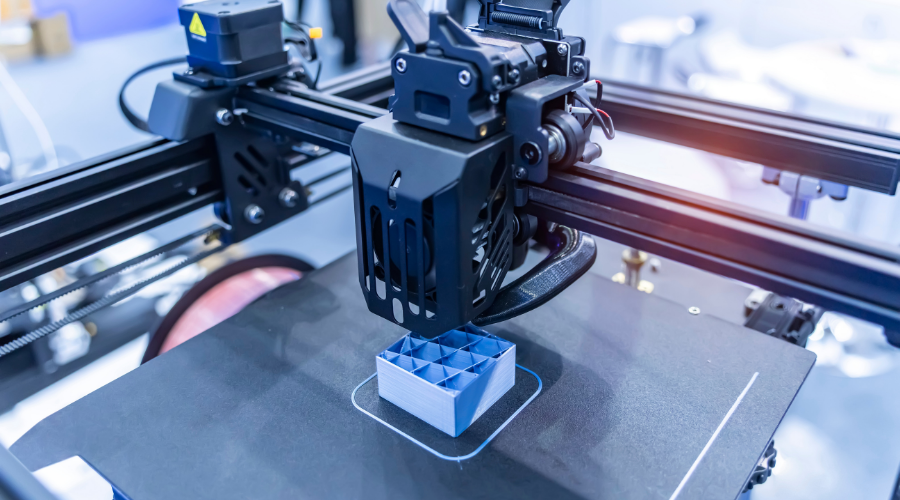
The aerospace 3D printing market is transforming how aircraft, spacecraft, and unmanned aerial systems are designed and manufactured. By producing components layer by layer from digital designs, additive manufacturing can reduce material waste, shorten development cycles, consolidate parts, and enable geometries that are difficult or uneconomical to produce through conventional methods.
The global aerospace 3D printing market was valued at USD 4.53 billion in 2025 and is projected to grow at a CAGR of 15.70% from 2026 to 2035, reaching approximately USD 19.47 billion by 2035. The projected expansion reflects increasing adoption of additive manufacturing across aircraft OEMs, space companies, defense programs, MRO operations, and specialized aerospace suppliers.
The technology is particularly valuable in aerospace because weight, reliability, lead time, and material utilization directly influence economics and performance. A component that weighs several kilograms less can generate benefits over thousands of flight hours, while consolidating multiple components into a single printed structure can reduce assembly requirements and potential failure points.
Aerospace 3D printing also supports a fundamental shift in product development. Engineers can move from designing around the limitations of traditional manufacturing toward designing around performance requirements and the capabilities of additive processes. Complex internal channels, lattice structures, topology-optimized components, and integrated assemblies can therefore become commercially practical.
However, aerospace is a demanding environment. Components must meet rigorous requirements for mechanical properties, fatigue resistance, temperature performance, traceability, repeatability, and certification. As a result, the industry’s transition toward additive manufacturing is not simply about buying more printers. It involves qualification, process control, material science, digital manufacturing, inspection, and long-term supply-chain management.
Additive Manufacturing Technologies Reshaping Aerospace Production
Powder bed fusion, polymerization, and material extrusion or fused deposition modelling are central technologies in aerospace 3D printing, with each suited to different materials, geometries, production volumes, and performance requirements. Technology selection ultimately depends on the component’s certification requirements and intended operating environment.
Powder bed fusion is particularly important for aerospace because it can manufacture complex metal and polymer components with relatively high geometric freedom. Processes such as selective laser melting, direct metal laser sintering, and electron beam melting can create components from alloys including titanium, aluminum, nickel-based superalloys, and other engineering materials.
The technology is attractive for components where lightweighting and geometric complexity justify the cost of powder and processing. Aerospace manufacturers can produce internal channels for cooling, optimized brackets, structural components, and engine-related parts that would require multiple manufacturing steps through conventional methods.
Polymerization, including stereolithography and related resin-based processes, uses light to cure liquid photopolymers into solid structures. These technologies are useful for prototypes, tooling, patterns, cabin components, and selected low-load applications where dimensional accuracy and surface quality are important.
Material extrusion, commonly associated with FDM, deposits thermoplastic material layer by layer. It is widely used for rapid prototyping, tooling, fixtures, manufacturing aids, and selected production components. Its relatively accessible equipment and broad material availability make it useful throughout aerospace engineering environments.
The important trend is that additive manufacturing is no longer confined to visual prototypes. Metal additive manufacturing is increasingly being considered for flight hardware and propulsion applications, while advanced polymer systems are moving into functional aerospace applications.
The Growing Importance of Powder Bed Fusion
Powder bed fusion is especially important because it combines high geometric freedom with the ability to process aerospace-grade metals and high-performance polymers. It enables designers to create lightweight structures, consolidate assemblies, and produce internal geometries that conventional machining cannot easily achieve.
The process can reduce the number of separate components in an assembly. Instead of machining and joining several pieces, engineers may redesign them as a single printed component. This can reduce fasteners, interfaces, welding, and assembly time.
The benefit becomes particularly compelling for low-volume aerospace production. Aircraft and spacecraft programs frequently require specialized parts in quantities too small to justify expensive tooling. Additive manufacturing can produce such components directly from qualified digital files, making it commercially attractive for replacement parts and customized production.
Materials, Printers, Software, and Services Form the Market’s Core
The aerospace 3D printing ecosystem extends well beyond printers. Materials, software, post-processing, inspection, certification, design engineering, and production services are becoming equally important as aerospace companies transition additive manufacturing from experimentation to repeatable production.
Metal powders are among the most strategically important materials. Titanium alloys are particularly attractive because of their high strength-to-weight ratio and corrosion resistance, while nickel-based superalloys can withstand demanding temperatures in propulsion environments. Aluminum alloys can support lightweight structures, and specialized steels and cobalt-chromium alloys have applications in particular aerospace systems.
Polymer materials also have a substantial role. Engineering thermoplastics can provide useful combinations of strength, chemical resistance, low density, and thermal performance. Advanced polymers are particularly valuable for cabin components, ducts, housings, brackets, tooling, and manufacturing aids.
The printer itself is only one part of the manufacturing chain. Software is increasingly central because additive manufacturing requires sophisticated design, build preparation, process simulation, parameter control, and production monitoring.
Companies such as Materialise have developed software and services that help manufacturers manage additive workflows, while Stratasys provides polymer additive manufacturing systems for aerospace applications. EOS has built a significant position in industrial additive manufacturing, particularly in metal and polymer systems.
Services are also important because not every aerospace organization wants to own and operate its entire additive manufacturing infrastructure. Specialized service providers can offer printing, design optimization, material expertise, post-processing, and inspection, allowing OEMs and smaller suppliers to adopt the technology without making the full capital investment.
The market is therefore increasingly becoming a complete digital manufacturing ecosystem in which qualified materials, printers, software, process parameters, inspection systems, and engineering expertise must work together.
Aircraft, Spacecraft, and UAV Applications Are Expanding
Aircraft remain a major application area, but spacecraft and UAV platforms are becoming increasingly important as aerospace organizations seek lightweight, rapidly manufacturable, and highly customized components. The technology is especially attractive when low production volumes and complex geometries make conventional tooling expensive.
In commercial aviation, 3D printing is used for cabin components, brackets, ducts, clips, tooling, fixtures, and increasingly sophisticated functional parts. Airlines and MRO providers can also benefit from producing replacement components closer to the point of use, potentially reducing inventory requirements and long supply-chain lead times.
Engine manufacturing represents another high-value application. Additive processes can produce complex fuel nozzles, heat exchangers, brackets, and other components where internal geometries and part consolidation provide significant performance benefits.
The space industry has embraced additive manufacturing particularly strongly because spacecraft often require lightweight components in small quantities. Rocket engines can contain highly complex cooling channels that are difficult to manufacture using conventional processes. Additive manufacturing can integrate such channels directly into the component.
NASA and commercial space companies have also investigated additive manufacturing for propulsion systems, structures, and in-space production. The attraction is straightforward: launching hardware into orbit is expensive, so reducing component mass and enabling production closer to the point of use can offer significant advantages.
UAVs represent another natural application because designers often prioritize low weight, aerodynamic efficiency, rapid iteration, and customized structures. Additive manufacturing can enable small UAV manufacturers to modify designs quickly without creating expensive tooling.
These applications demonstrate why aerospace 3D printing is not one homogeneous market. A commercial aircraft bracket, rocket-engine component, UAV airframe component, and maintenance fixture may all use additive manufacturing but require completely different materials, qualification procedures, economics, and production strategies.
OEM Production and MRO Are Driving Commercial Adoption
OEMs are using 3D printing to redesign and manufacture new aerospace systems, while MRO organizations are adopting it to reduce lead times, simplify inventories, and produce specialized replacement components. Together, these end-use markets provide complementary growth opportunities.
For OEMs, additive manufacturing offers the greatest value when it is incorporated into the design stage rather than added after a component has already been optimized for conventional production.
Designers can use topology optimization and generative design to remove material from low-stress areas while retaining structural performance. The resulting geometry may be extremely difficult to machine but comparatively straightforward to print.
This changes the economics of component development. A conventional component may require forging, machining, drilling, joining, and finishing. A redesigned additive component may combine several of those stages into a single build followed by post-processing and inspection.
MRO applications have a different value proposition. Airlines and maintenance providers deal with thousands of components, some of which are difficult to source or have long lead times. If a qualified digital manufacturing file exists, additive manufacturing can potentially produce certain replacement components without maintaining large physical inventories.
However, digital inventory does not eliminate certification requirements. An aerospace component must still be manufactured using approved materials, processes, equipment, and inspection procedures. Traceability remains essential.
This is why MRO adoption is likely to expand first in applications where certification pathways are established and the economic benefits are clear, such as tooling, cabin components, non-critical hardware, and selected replacement parts.
Tooling, Prototyping, and Functional Parts Are Creating Value
Aerospace companies increasingly use additive manufacturing for tooling and prototyping because these applications offer immediate economic benefits without requiring the same qualification burden as flight-critical components. As process maturity improves, functional production parts are becoming the next major growth area.
Tooling is one of the most commercially established applications. Printed jigs, fixtures, drill guides, assembly aids, and molds can be produced much faster than conventionally manufactured equivalents. Lightweight printed tools can also be easier for technicians to handle.
Prototyping remains important because aerospace development involves extensive design iteration. Engineers can print test components within days rather than waiting weeks for conventional tooling or machining. This accelerates testing and helps teams identify design problems earlier.
The transition toward functional parts is strategically more significant. Once an additive process is qualified for a specific material and geometry, the technology can move from development support into production.
Velo3D, for example, has positioned its metal additive manufacturing technology around complex production components, while Norsk Titanium has focused on large-scale titanium additive manufacturing for aerospace structures. These approaches demonstrate how different additive platforms target different parts of the aerospace value chain.
The commercial tipping point occurs when the total cost of an additive component—including printing, powder, post-processing, inspection, and certification—is lower than the lifecycle cost of its conventional alternative. That calculation can include not only manufacturing cost but also tooling, inventory, assembly, transportation, and future replacement requirements.
Regional Trends Across North America, Europe, and Asia Pacific
North America remains a leading aerospace 3D printing region because of its large aerospace and defense industry, strong additive manufacturing ecosystem, and substantial investment in space technologies. Europe is also highly active, while Asia Pacific is emerging as an important growth market as aerospace manufacturing capacity expands.
The United States benefits from the presence of major aerospace OEMs, defense contractors, space companies, additive manufacturing developers, and research institutions. Companies such as Lockheed Martin, Aerojet Rocketdyne, and other major aerospace organizations have invested in additive manufacturing for propulsion, spacecraft, tooling, and production components.
Europe has a similarly sophisticated ecosystem, supported by aircraft manufacturing, engine development, aerospace research, and industrial additive manufacturing companies. Safran Group and MTU Aero Engines are examples of major aerospace companies exploring additive manufacturing within aircraft and propulsion applications.
Germany’s industrial base has also contributed to the region’s strength, particularly in metal additive manufacturing and aerospace-engine applications. European companies often place strong emphasis on qualification, process monitoring, material traceability, and manufacturing standards.
Asia Pacific is expected to gain importance as countries such as China, Japan, India, Singapore, and South Korea expand aerospace and advanced-manufacturing capabilities. The region’s large electronics, automotive, industrial, and engineering sectors provide a strong foundation for additive manufacturing expertise that can transfer into aerospace.
Latin America and the Middle East and Africa represent smaller markets but offer opportunities through aircraft maintenance, defense modernization, space initiatives, and localized manufacturing. As additive technologies become easier to deploy, regional MRO centers could become important users of distributed manufacturing.
Competitive Landscape and Leading Aerospace 3D Printing Companies
Competition is becoming more sophisticated as established additive manufacturing companies compete alongside aerospace OEMs, defense contractors, materials suppliers, and specialized production firms. Market leadership increasingly depends on complete production capabilities rather than printer performance alone.
The companies covered in the market include Stratasys Ltd., 3D Systems, Inc., EOS GmbH Electro Optical Systems, Norsk Titanium US Inc., Ultimaker BV, Materialise NV, Aerojet Rocketdyne Holdings Inc., Velo3D Inc., Desktop Metal Inc. (ExOne), MTU Aero Engines AG, Lockheed Martin Corporation, and Safran Group, among others.
Stratasys has a strong position in polymer additive manufacturing and serves aerospace customers with systems, materials, and application expertise. 3D Systems has a broad portfolio spanning metal and polymer technologies, while EOS is a major industrial additive manufacturing provider with substantial expertise in powder bed processes.
Norsk Titanium occupies a more specialized position through its large-scale titanium additive manufacturing approach, targeting structural aerospace components. Velo3D focuses on metal additive manufacturing for complex parts, particularly where conventional production can be difficult.
Materialise occupies an important position in software and additive manufacturing services, highlighting the growing importance of the digital layer. Aerospace companies increasingly need software capable of managing design, build preparation, traceability, simulation, and production data.
Meanwhile, aerospace OEMs and propulsion companies such as Lockheed Martin, Safran, and MTU Aero Engines are not simply customers. They increasingly influence the technology’s development by qualifying processes, redesigning components, and establishing production standards.
This creates a market where hardware suppliers, software companies, materials developers, service bureaus, and aerospace manufacturers increasingly operate as an interconnected ecosystem.
Certification, Cost, and Production Challenges
Aerospace 3D printing still faces significant challenges involving certification, process repeatability, material qualification, post-processing, production economics, and workforce expertise. These barriers are particularly important for safety-critical components where manufacturing variation cannot be tolerated.
Certification is arguably the industry’s most significant hurdle. Aerospace components must meet strict requirements for mechanical performance, fatigue behavior, thermal resistance, dimensional accuracy, and long-term reliability. Additive manufacturing introduces process variables that must be tightly controlled and documented.
Post-processing can also add considerable cost. Printed metal parts may require heat treatment, support removal, machining, surface finishing, hot isostatic pressing, or other processes before they can enter service.
Production speed remains another consideration. Additive manufacturing can be economically compelling for complex, low-volume components, but conventional processes may remain cheaper for simple parts produced in enormous quantities.
Material cost can also be high, particularly for aerospace-grade metal powders and high-performance polymers. Powder recycling and quality control must be carefully managed because contamination or changes in material characteristics can affect component performance.
Workforce expertise is another constraint. Aerospace additive manufacturing requires engineers who understand both traditional aerospace design and additive-specific phenomena such as anisotropy, support strategy, thermal history, residual stress, and build orientation.
Consequently, the industry’s growth will depend not only on better printers but also on better processes, standards, simulation, inspection, and workforce capabilities.
Future Outlook for the Aerospace 3D Printing Market
The aerospace 3D printing market is moving toward broader production use as additive manufacturing becomes more reliable, qualified, and economically attractive. The strongest growth is likely to come from applications where lightweighting, part consolidation, complex geometries, low production volumes, and rapid supply are particularly valuable.
The projected increase from USD 4.53 billion in 2025 to USD 19.47 billion by 2035 illustrates the scale of the opportunity. However, market expansion should not be interpreted as universal replacement of conventional manufacturing. Additive manufacturing will continue to coexist with casting, forging, machining, composites, and other established technologies.
The real competitive advantage lies in choosing the right process for the right component. A highly complex titanium bracket may be ideal for additive manufacturing, while a simple high-volume fastener may remain better suited to conventional production.
Over time, the industry is likely to see greater use of digital inventories, automated quality inspection, AI-assisted design, advanced process monitoring, larger-format metal printing, and improved material qualification. These developments could make distributed manufacturing more practical and reduce dependence on centralized inventories.
Space manufacturing may push the technology even further by creating demand for components that can be produced in orbit or on other planetary surfaces. Meanwhile, commercial aviation and defense programs will continue to focus on certified lightweight components, engine parts, tooling, and maintenance applications.
The long-term opportunity is therefore not simply the production of more 3D-printed parts. It is the development of a digital aerospace manufacturing ecosystem in which design, materials, machines, software, inspection, certification, and supply chains are connected. Companies that can control multiple parts of that ecosystem will be well positioned as additive manufacturing moves from an engineering innovation toward a mainstream aerospace production technology.