For millions of Muslims, the biggest barrier to learning Islam is not a lack of interest.
It is language.
A student may find a detailed Islamic article in English but understand Urdu more comfortably. Another person may speak Urdu fluently but struggle to read the Urdu script. A young Muslim may naturally communicate online using Roman Urdu rather than formal Urdu or English.
At the same time, much of classical Islamic scholarship originates in Arabic.
This creates a complicated language gap between Islamic sources and the people trying to understand them.
Artificial intelligence has the potential to reduce that gap.
Multilingual AI can allow Muslims to ask questions in the language they naturally use, receive explanations they understand more easily, and discover relevant Islamic sources without first mastering another language.
For Islamic education, this could be one of AI’s most valuable applications.
Language Has Always Mattered in Education
People generally understand difficult ideas more easily when those ideas are explained in a familiar language.
Islamic education is no exception.
A student trying to understand concepts such as Tawakkul, Qadar, Ijtihad, Zakat, or different schools of Fiqh may already be dealing with a complex subject.
Adding an unfamiliar language creates another difficulty.
The learner must first understand the language and then understand the religious concept.
Multilingual technology can reduce the first obstacle.
Instead of forcing every Muslim to phrase a question in formal English, an AI learning system can potentially allow users to interact using the language they are most comfortable with.
This can make Islamic knowledge feel considerably more accessible.
The Muslim World Is Deeply Multilingual
Islam is a global religion.
Muslims live across South Asia, Southeast Asia, the Middle East, Africa, Europe, North America, and many other regions.
They communicate in hundreds of languages.
Arabic holds a special position because it is the language of the Quran and an enormous body of Islamic scholarship.
However, most Muslims worldwide are not native Arabic speakers.
Many therefore learn about Islam through translations and explanations in languages such as:
- English
- Urdu
- Persian
- Turkish
- Indonesian
- Malay
- French
- Bengali
- Swahili
- Hausa
- German
- Spanish
Digital Islamic education has already made these materials easier to access.
Multilingual AI could make them easier to navigate.
Pakistan Shows Why Roman Urdu Matters
Pakistan provides a particularly interesting example.
A large number of people speak and understand Urdu, while English is widely used in education, business, and digital communication.
But online conversations often introduce a third format:
Roman Urdu.
Instead of writing:
“صبر کیا ہے؟”
a user might type:
“Sabr kya hai?”
Or instead of asking in English:
“What does Islam say about patience?”
someone may naturally write:
“Islam me sabr ke bare me kya kaha gaya hai?”
For many Pakistanis, this is simply how digital communication works.
Roman Urdu is commonly used in:
- WhatsApp messages
- Social media
- Search queries
- Online discussions
- Comments
- Informal educational conversations
Yet Roman Urdu creates challenges for traditional search technology because it has no universally standardized spelling.
One person might write:
Namaz
Another:
Namaaz
Another:
Nimaz
Humans usually understand that these refer to the same concept.
Computer systems need to learn how to recognize these variations.
Recent natural language processing research continues to classify Roman Urdu as a low-resource and highly variable language form, highlighting inconsistent spellings and informal grammatical structures as important technical challenges.
Multilingual AI Changes the Search Experience
Traditional search often depends heavily on the words typed by the user.
AI can potentially go further.
Instead of looking only for exact keywords, modern language systems can try to understand the meaning behind the question.
Consider:
“Namaz me concentration kese improve kro?”
A multilingual Islamic AI system could potentially identify that the user is asking about concentration or Khushu during Salah.
It could then connect the question with relevant Islamic concepts even though the user did not know the technical Arabic terminology.
This creates an important bridge.
The learner does not always need to know the correct scholarly vocabulary before beginning the search.
AI can help connect everyday language with established Islamic terminology.
Islamic Knowledge Becomes Easier for Beginners
Beginners often face a vocabulary problem.
Someone exploring Islam may encounter words such as:
- Tawheed
- Sunnah
- Tafsir
- Fiqh
- Ijma
- Qiyas
- Madhhab
- Ijtihad
The learner may not know what these words mean, let alone which books to consult.
Multilingual AI can provide an entry point.
A user might ask:
“Madhhab kya hota hai?”
The system could first provide a simple explanation.
The learner could then continue:
“Four major madhahib kon se hain?”
Then:
“Hanafi aur Shafi’i Fiqh me difference kyun hota hai?”
The conversation gradually moves from simple language toward deeper Islamic learning.
This type of progressive explanation can be particularly valuable for younger learners and people beginning formal Islamic study.
Multilingual AI Can Help New Muslims
Language accessibility also matters for new Muslims.
A person who recently accepted Islam may already be learning unfamiliar beliefs, practices, Arabic terminology, and community traditions.
If useful educational resources are also written in difficult language, the learning experience can quickly become overwhelming.
AI can help simplify the first stage of that journey.
A new Muslim could ask:
“What is Wudu?”
Then:
“Explain it in simple Urdu.”
Then:
“Can you explain the Arabic terms used during prayer?”
The ability to adjust language and complexity can make Islamic learning more approachable.
AI should not replace teachers or Muslim communities, but it can reduce the friction between having a question and beginning to understand it.
IlmVerse and Multilingual Islamic Questions
Purpose-built Islamic AI platforms are beginning to recognize this need.
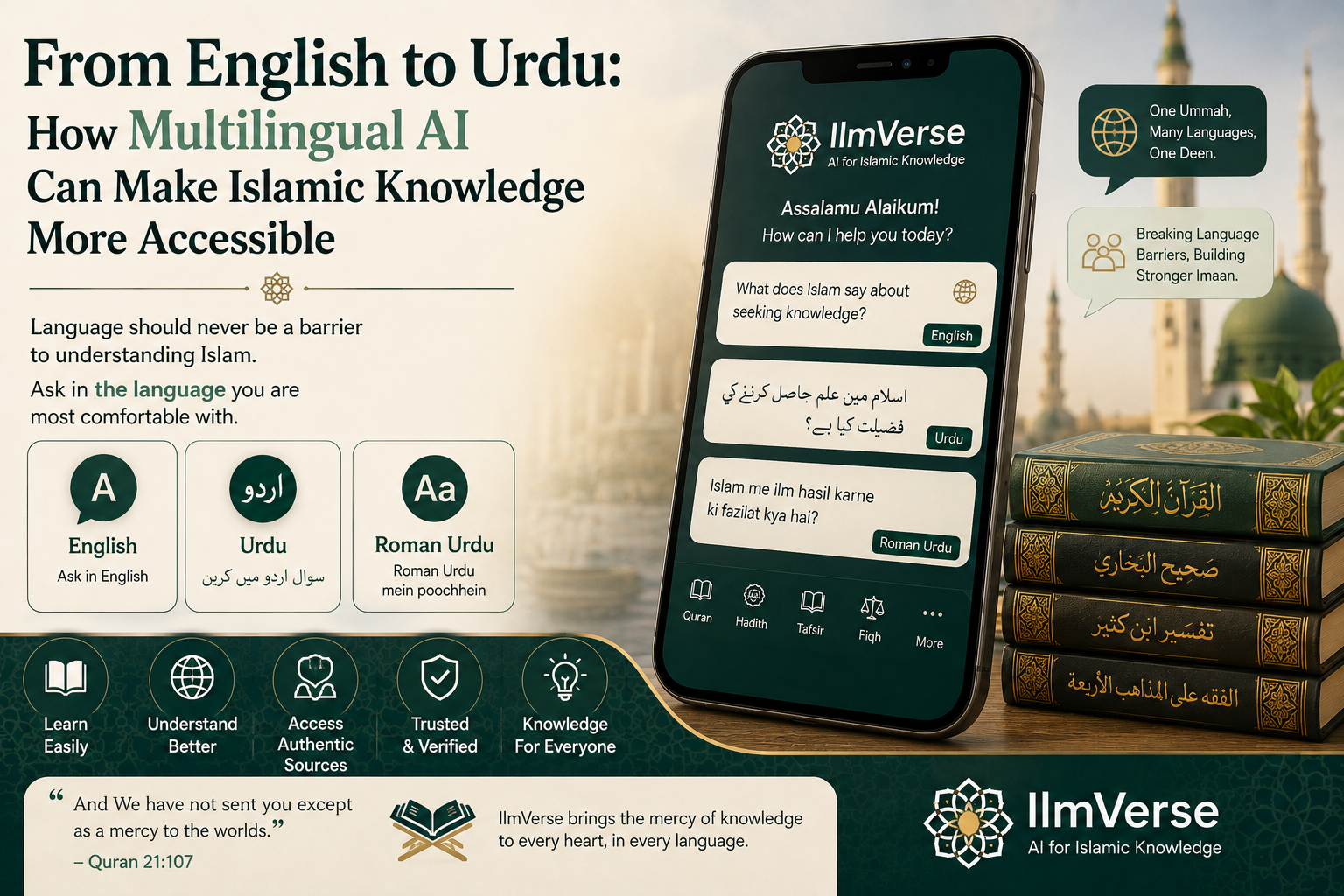
For example, IlmVerse allows users to ask Islamic questions in English, Urdu, and Roman Urdu.
This is particularly significant for users who understand Islamic discussions better in Urdu but naturally type online using the Roman alphabet.
Rather than requiring users to adapt themselves to the technology, the technology can begin adapting to the user’s language.
That represents an important shift in digital Islamic education.
The value is not simply translation.
It is allowing more people to begin the process of seeking Islamic knowledge in a way that feels natural to them.
Translation Alone Is Not Enough
Multilingual Islamic AI also introduces serious challenges.
Translating ordinary conversation is one thing.
Translating Islamic terminology is much more complicated.
Some Arabic terms cannot be represented perfectly with a single English or Urdu word.
Consider:
Taqwa
It may be translated using concepts such as God-consciousness, piety, awareness of Allah, or fear of Allah.
Each expression captures part of the meaning, but none necessarily communicates every dimension of the original term.
The same challenge appears with words such as:
- Deen
- Fitnah
- Ibadah
- Ihsan
- Shirk
- Fitrah
- Barakah
- Qadar
A good multilingual Islamic system should therefore avoid assuming that translation is always a simple word-for-word process.
Sometimes the original Arabic term should be preserved while the meaning is explained.
Quran Translation Requires Special Care
This distinction becomes even more important with the Quran.
A translation of the Quran is an explanation of meaning.
It is not identical to the original Arabic Quranic text.
When AI provides translated Quranic material, users should ideally be able to identify:
- The Surah
- The verse number
- The Arabic text where appropriate
- The translation used
- Relevant Tafsir when interpretation matters
AI should help users reach the Quran rather than make its own generated wording appear like Quranic text.
This is an important safeguard for multilingual Islamic AI.
Hadith Translation Can Also Change Meaning
Hadith presents similar difficulties.
A narration translated from Arabic into English and then simplified into Urdu may gradually lose important nuances.
Technical religious terminology can become oversimplified.
The meaning of a word may depend on historical or legal context.
For this reason, multilingual AI should ideally preserve links between the explanation and the original source.
If the user receives an Urdu explanation of a Hadith, they should still be able to identify which Hadith is being discussed.
Language accessibility should increase verification rather than weaken it.
Source-Backed AI Becomes Even More Important Across Languages
Multilingual generation creates another risk.
The further an answer moves across languages, the easier it can become for subtle errors to appear.
A system may correctly retrieve an Islamic concept but translate it poorly.
Or it may generate a very natural Urdu explanation that is not fully supported by the original source.
This is why multilingual Islamic AI should be combined with source retrieval.
A stronger process would look like:
Question in Urdu or Roman Urdu
↓
Understand the intended meaning
↓
Retrieve relevant Islamic sources
↓
Generate an explanation in the user’s language
↓
Show references
The source remains the foundation.
Language becomes the bridge.
AI Could Make Classical Scholarship Easier to Discover
One of the most exciting future possibilities is connecting modern questions with classical scholarship.
Imagine a learner asking in Roman Urdu:
“Business me advance payment lena jaiz hai?”
The user may not know which Arabic Fiqh terminology describes the transaction.
An advanced retrieval system could identify the concepts involved and locate potentially relevant discussions in Islamic legal literature.
The AI could then provide an introductory explanation in Urdu.
This would not automatically produce a fatwa.
But it could help the learner understand the issue and identify the questions that should be discussed with a qualified scholar.
Multilingual AI therefore has potential not merely as a translation tool but as a bridge between everyday language and specialized Islamic literature.
Islamic Teachers Can Reach Wider Audiences
The benefits are not limited to students.
Teachers and Islamic organizations could also use multilingual AI.
An educator who prepares a lesson in English could create simplified supporting explanations for Urdu-speaking students.
An Islamic institution could make educational material searchable in multiple languages.
A mosque serving a diverse community could make introductory information easier to access.
A teacher could prepare:
- English lesson notes
- Urdu summaries
- Vocabulary explanations
- Student FAQs
- Beginner-friendly versions
- Multilingual quizzes
AI can reduce the repetitive work involved in adapting educational resources for different audiences.
The teacher would still need to review the religious accuracy and quality of the material.
Language Access Can Support the Muslim Diaspora
Multilingual Islamic learning is also relevant outside Muslim-majority countries.
A Muslim family living in the United Kingdom, Canada, Australia, or the United States may use several languages at home.
Parents may prefer Urdu.
Children may be stronger in English.
Grandparents may communicate mainly in their native language.
Traditional Islamic vocabulary may move between Arabic and both languages.
A multilingual Islamic learning platform could help these generations explore the same subjects in different ways.
For example, a parent might study an explanation in Urdu while a teenager reads a simpler English version.
Technology can therefore support access across both geography and generations.
Multilingual Does Not Automatically Mean Accurate
It is important to avoid another misconception:
Supporting more languages does not automatically make an AI system better.
The system must understand those languages well.
Low-resource languages often have fewer high-quality datasets available for AI training.
Roman Urdu adds additional complexity because spelling varies significantly.
An AI may misunderstand:
- Informal spellings
- Mixed Urdu-English sentences
- Religious Arabic terms
- Local expressions
- Transliteration differences
For example:
“Roza toot jata hai?”
and
“Fast break hojata hai?”
could represent almost the same question.
A multilingual system must understand meaning rather than simply translate individual words.
This remains an active technical challenge.
AI Should Preserve Scholarly Differences Across Languages
There is another subtle issue.
When complex Islamic discussions are simplified into another language, legitimate differences of scholarly opinion can disappear.
A detailed Arabic Fiqh discussion might present several views with qualifications.
A simplified AI translation could incorrectly compress this into:
“Islam says X.”
This is dangerous.
Good multilingual Islamic AI should preserve distinctions such as:
- Which school holds a particular position
- Whether scholars disagree
- Whether an opinion is conditional
- Whether there is consensus
- Whether the question requires personal circumstances to be considered
Accessibility should not come at the cost of scholarly accuracy.
A Better Model for Multilingual Islamic AI
A responsible multilingual Islamic system should ideally follow several principles.
Understand the User’s Natural Language
Allow users to ask questions naturally rather than requiring formal terminology.
Preserve Original Islamic Terms
Do not translate away important Arabic concepts when doing so reduces meaning.
Retrieve Before Generating
Connect answers with established Islamic sources.
Provide References
Allow users to verify Quranic, Hadith, and scholarly claims.
Recognize Scholarly Differences
Do not erase legitimate Fiqh diversity during simplification.
Admit Uncertainty
If the system cannot confidently understand a Roman Urdu phrase or translate a technical concept, it should say so.
Direct Sensitive Questions to Scholars
Multilingual accessibility should not turn AI into an automated fatwa service.
AI Can Expand Access Without Replacing Teachers
International education research increasingly emphasizes the importance of learning through languages people understand.
Technology can support this.
But technology does not remove the importance of human educators.
A good Islamic teacher provides much more than translated information.
Teachers provide:
- Context
- Correction
- Methodology
- Mentorship
- Adab
- Spiritual guidance
- Human understanding
AI can help a student understand the words.
A teacher helps the student understand how knowledge should be learned and lived.
The strongest educational model combines both.
From Language Barrier to Knowledge Bridge
For decades, the internet dramatically expanded access to Islamic information.
Multilingual AI could make the next major improvement.
The question may no longer need to be:
“Can I find an Islamic article in the language I understand?”
Instead, a learner may simply ask a question naturally and receive guidance toward relevant Islamic knowledge.
Someone could type in English.
Another person could ask in Urdu.
Another could use Roman Urdu.
The underlying Islamic sources could remain the same.
Only the path toward understanding them changes.
That is the real promise of multilingual Islamic AI.
Conclusion
Islamic knowledge belongs to a global Muslim community that speaks many different languages.
Language should not become an unnecessary barrier between a sincere learner and reliable knowledge.
Multilingual AI can help by allowing users to ask questions naturally, simplifying unfamiliar terminology, connecting modern language with classical concepts, and making Islamic educational resources easier to explore.
For Pakistan and Urdu-speaking communities in particular, support for both Urdu and Roman Urdu can make digital Islamic learning significantly more practical.
But accessibility must remain connected to authenticity.
Translations need context.
Quran and Hadith references need verification.
Scholarly differences need to be preserved.
Complex religious rulings still require qualified scholars.
The future of Islamic AI should therefore not simply be about making machines speak more languages.
It should be about helping more people, across more languages, reach authentic Islamic knowledge with clarity, confidence, and responsibility.