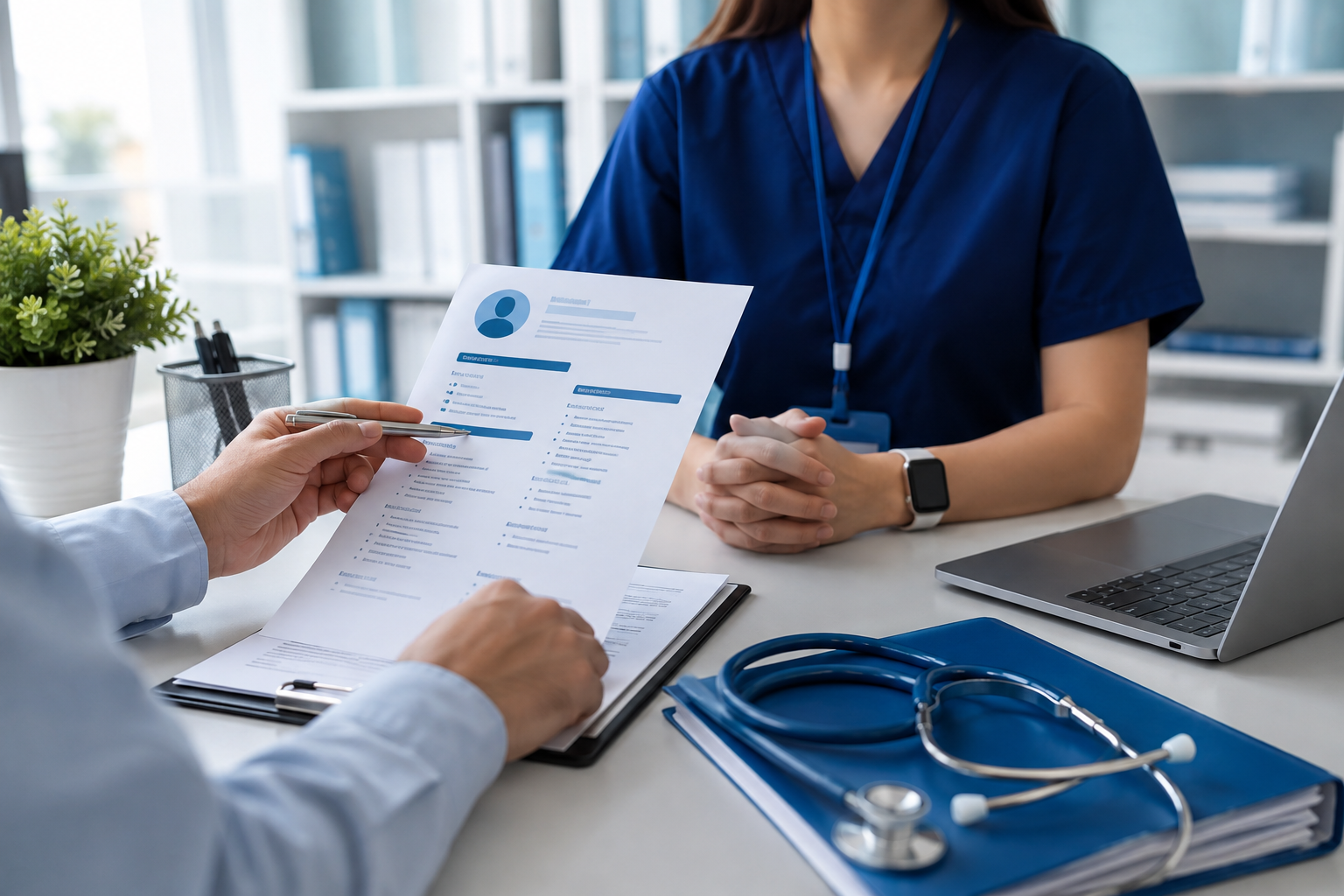
A modern healthcare resume should do more than explain where you have worked. It should give employers a clear idea of how you think, how you adapt, what you contribute, and where your career is heading.
That matters because healthcare itself is changing. Hospitals and health systems are adjusting staffing models, expanding digital health capabilities, introducing AI-supported tools, and creating roles that did not exist in the same form a few years ago. The American Hospital Association’s 2026 workforce research points to growing demand for digital fluency, team-based care, and new capabilities around areas such as AI, virtual care, and complex care coordination.
For healthcare professionals, this creates a different resume challenge. Your document needs to communicate traditional clinical credibility while also showing that you can operate effectively in a changing healthcare environment.
Your Resume Should Explain Who You Are Professionally
A recruiter should not have to read your entire employment history to understand your professional identity.
Are you an experienced registered nurse specializing in critical care? A healthcare administrator moving toward operational leadership? A medical professional with growing experience in digital health? A clinical specialist who works across multidisciplinary teams?
Your resume should make that direction obvious.
This doesn’t mean writing a long personal statement. A focused opening section can establish your specialty, experience level, strongest area of contribution, and the type of work you are prepared to take on next.
The goal is clarity.
A candidate who appears professionally focused is easier for a recruiter to remember than someone whose resume contains a long list of unrelated skills.
Healthcare Experience Needs Context
Job titles alone don’t tell employers enough.
“Clinical Coordinator” could describe very different responsibilities depending on the organization. The same is true for nurses, therapists, medical assistants, administrators, pharmacists, and other healthcare professionals.
A modern resume gives context around the work.
Instead of simply saying you coordinated patient care, explain the environment in which you did it. Perhaps you worked across multiple departments, supported a complex patient population, coordinated high-volume services, or helped improve communication between clinical teams.
Context makes experience more believable.
It also helps employers understand the level of responsibility you’ve actually handled.
Digital Health Is Becoming Part of the Career Story
Technology should not dominate every healthcare resume, but ignoring it completely can make a professional profile look dated.
The World Health Organization’s 2026 analysis of digital health competencies identifies areas including data, informatics, communication, technical proficiency, digital professionalism, and administration as important parts of a digitally evolving health workforce.
That doesn’t mean every healthcare professional needs to present themselves as a technology expert.
Instead, your resume should show how technology fits into your actual work.
You might have experience with:
- Electronic health records
- Telehealth platforms
- Clinical documentation systems
- Digital patient communication
- Healthcare data tools
- Remote monitoring
- AI-supported workflows
The important point is not simply naming the technology. Explain what you used it to accomplish when relevant.
AI Experience Needs a Human Context
AI is becoming part of healthcare conversations, but a modern resume shouldn’t imply that technology replaces professional judgment.
The more useful message is that you can work responsibly alongside new tools.
The American Hospital Association notes that healthcare organizations are building the foundation for AI while redesigning processes around it, rather than treating technology as a replacement for healthcare teams.
That distinction matters.
If you’ve participated in technology implementation, workflow redesign, data-related projects, or training around new systems, describe your role honestly.
For example, helping staff adopt a new digital workflow demonstrates adaptability. Evaluating whether a technology actually improves a process demonstrates judgment.
Those are stronger signals than simply adding “AI” to a skills list.
Show That You Can Work Across Teams
Healthcare is rarely a one-person environment.
Patients move between departments. Physicians work with nurses and specialists. Administrators coordinate with clinical teams. Digital health professionals may work with clinicians, analysts, and technology teams.
Modern employers therefore need people who can communicate across professional boundaries.
Your resume can demonstrate this through examples of collaboration.
Perhaps you coordinated with physicians and case managers to improve discharge planning. Maybe you worked with IT staff during an EHR transition. You could have trained colleagues, supported interdisciplinary meetings, or helped introduce a new process across departments.
These examples show something a job title cannot: how you operate with other people.
Patient Care Still Needs to Stay at the Center
Technology and workforce changes shouldn’t make a healthcare resume sound like a technology resume.
Healthcare remains fundamentally about people.
Patient communication, safety, empathy, clinical judgment, advocacy, and quality of care continue to matter. Even when applying for administrative or technology-oriented healthcare roles, understanding the patient and provider experience can be a meaningful advantage.
A strong resume balances both sides.
It can show digital fluency without losing the human side of healthcare.
It can demonstrate efficiency without making patient care sound secondary.
That balance is increasingly important as healthcare organizations try to improve productivity while maintaining trust and quality.
Skills Should Reflect What You Can Actually Do
A long skills section can make a resume look impressive at first glance, but it doesn’t necessarily make the candidate more credible.
A better approach is to prioritize skills that connect directly to your target role.
For example, a healthcare professional applying for a care coordination position might emphasize care planning, interdisciplinary communication, patient navigation, documentation, and transitions of care.
Someone targeting healthcare operations may need to emphasize workflow improvement, team coordination, compliance, resource management, and process analysis.
The skills should reflect the job you want—not simply everything you’ve ever encountered.
Current workforce research also shows that healthcare roles remain highly specialized, with a large share of required skills concentrated within healthcare and caregiving competencies.
That makes precision especially important.
Your Resume Should Show Learning, Not Just Experience
Years of experience are useful, but employers also want evidence that your capabilities have developed during those years.
Maybe you moved from direct patient care into coordination. Perhaps you became responsible for training new employees. You may have learned a new clinical system, completed specialized education, joined a quality improvement initiative, or taken responsibility for a more complex patient population.
These developments create a career narrative.
They show that your experience isn’t simply accumulating—it is evolving.
This is particularly useful for professionals who have stayed with one employer for many years. Without careful presentation, a long tenure can look repetitive. With the right details, it can demonstrate increasing trust and responsibility.
Make Your Next Career Move Make Sense
One of the most useful questions to ask before updating a resume is:
“What should an employer believe I am ready for next?”
Your answer should influence what you emphasize.
If you’re moving into management, highlight leadership and operational responsibility.
If you’re moving into a specialty, bring relevant clinical exposure forward.
If you’re transitioning toward digital health, demonstrate the connection between your healthcare knowledge and technology experience.
If you’re seeking a more senior position, make increasing responsibility visible.
A resume becomes much stronger when the next step feels like a logical continuation of the career rather than a random application.
Professional Presentation Still Matters
Modern doesn’t mean complicated.
A healthcare resume should be easy to scan, professionally structured, and comfortable to read on a computer or mobile device. Clear headings, consistent spacing, concise descriptions, and sensible section ordering usually matter more than decorative design.
The document should also avoid unnecessary information that distracts from your professional story.
Your goal isn’t to make the resume visually impressive.
Your goal is to make the information easy to understand.
This is one area where Professional healthcare resume writing services can be useful for candidates who know their field well but struggle to decide which experience deserves the most attention.
The Human Side Can Become Your Advantage
As healthcare becomes more digital, distinctly human qualities may become even more important.
Communication, empathy, ethical judgment, teamwork, patient advocacy, and the ability to handle difficult situations are difficult to capture through technology alone.
Don’t hide these qualities behind generic phrases.
Instead, demonstrate them through real examples.
“Excellent communication skills” is a claim.
“Coordinated communication between patients, families, and multidisciplinary care teams during complex treatment planning” provides evidence.
That difference makes a resume feel more authentic.
What a Modern Healthcare Resume Should Ultimately Communicate
A strong healthcare resume should leave recruiters with a simple impression:
This professional understands healthcare, keeps learning, adapts to change, and can make a meaningful contribution.
It should show where you’ve been, but it should also suggest where you’re capable of going.
That is increasingly important as healthcare organizations redefine workforce needs around technology, team-based care, digital capabilities, and evolving models of service delivery.
For professionals who need help translating years of experience into that kind of career story, Professional healthcare resume writing services can provide an outside perspective on positioning, structure, and content.
The strongest modern resume isn’t the one that contains the most information. It’s the one that makes the right information impossible to overlook.
Frequently Asked Questions
What should a modern healthcare resume focus on?
It should communicate relevant expertise, adaptability, professional growth, digital capabilities, collaboration, and the value you can bring to the target role.
Should healthcare professionals mention AI on their resumes?
Only when they have genuine experience with AI-related tools, implementation, training, workflow changes, or relevant projects. It should never be added simply because AI is trending.
How important is digital health experience?
Its importance depends on the role, but digital tools are becoming increasingly relevant across healthcare. Relevant experience with EHRs, telehealth, data, or other digital systems can strengthen a resume when presented with context.
Should a healthcare resume include soft skills?
Yes, but demonstrate them through experience rather than creating a long list. Examples of teamwork, communication, leadership, patient advocacy, and problem-solving are more convincing than unsupported claims.
Can professional resume services help experienced healthcare professionals?
Yes. Professional healthcare resume writing services can help experienced candidates identify the strongest parts of their career history and present them in a focused way that supports their next career goal.