Introduction
If you’ve ever had a patient on clozapine and felt a quiet knot of anxiety tighten in your chest during handover, you’re not alone. The Clozapine Monitoring Survival Guide exists precisely because this medication — as powerful and life-changing as it is — demands a level of clinical vigilance that most other psychiatric drugs simply don’t.
Nurses describe it as one of the most rewarding medications to manage when you know what you’re doing, and one of the most anxiety-inducing when you don’t. This article breaks down what clozapine monitoring actually looks like in practice: the bloodwork thresholds, the red-flag side effects, the documentation habits, and the patient conversations that keep people safe.
What Makes Clozapine Different from Other Antipsychotics
Clozapine sits in a category of its own. It’s the only medication currently approved specifically for treatment-resistant schizophrenia, which means it’s typically prescribed after two or more other antipsychotics have failed to control symptoms. For many patients, it genuinely changes their lives — reducing hallucinations, stabilizing mood, and in some cases dramatically lowering suicide risk. So why isn’t it used more often?
The answer comes down to risk. Clozapine carries a well-documented risk of agranulocytosis — a potentially fatal drop in white blood cells that leaves the body dangerously vulnerable to infection. That’s not a theoretical risk buried in a package insert. It’s the reason every patient on this medication must be enrolled in a mandatory monitoring program, and why nurses who manage these patients carry real clinical responsibility every single shift.
There’s also metabolic syndrome, sedation, hypersalivation, constipation (which can become life-threatening if ignored), myocarditis, seizures, and orthostatic hypotension to contend with. None of this means clozapine is bad. It means it requires nurses who know it well.
Understanding ANC Thresholds: The Numbers That Matter
Absolute Neutrophil Count (ANC) monitoring is the backbone of safe clozapine management. These numbers aren’t arbitrary — they’re the early warning system that catches agranulocytosis before it becomes fatal.
The monitoring schedule changes based on how long a patient has been on the medication. During the first six months, bloodwork is typically required weekly. From months six to twelve, it drops to every two weeks. After a full year of stability, monthly monitoring is usually sufficient — though your employer’s protocol and regional guidelines always take precedence.
Here’s the general framework most clinicians work from:
- ANC ≥ 1500/mm³ — Green zone. Continue therapy, proceed as normal.
- ANC 1000–1499/mm³ — Yellow zone. Increase monitoring frequency. Don’t stop the medication yet, but watch closely.
- ANC < 1000/mm³ — Red zone. This is a medical emergency. Clozapine must be discontinued immediately, and the prescriber needs to be notified right away.
These numbers apply to the general population. For patients of Benign Ethnic Neutropenia (BEN) — a condition more prevalent in people of African, Middle Eastern, and some Mediterranean backgrounds — the thresholds are adjusted downward because their baseline neutrophil counts are naturally lower. Using standard thresholds in these patients leads to unnecessary discontinuation of a medication that’s actually working. This is one of those clinical nuances that textbooks gloss over but real-world nursing absolutely can’t.
Recognizing Side Effects Before They Become Emergencies
Not every side effect is immediately dangerous, but some escalate fast if you miss them early. The key is knowing which category each symptom falls into.
Agranulocytosis is the one everyone fears, and rightly so. The catch is that it doesn’t always announce itself dramatically. Early signs can mimic a mild cold — sore throat, low-grade fever, general malaise. A patient who says “I feel a bit off” three weeks into their clozapine therapy needs their ANC checked, not reassurance. That’s the mindset shift clozapine nursing requires.
Myocarditis is another serious one that tends to emerge in the first month of treatment. Patients may complain of chest pain, shortness of breath, or palpitations. Fever with no clear infectious source is another signal. Any of these warrant escalation and, in most settings, an ECG and troponin level at minimum.
Constipation gets underestimated constantly. Clozapine slows gastrointestinal motility significantly, and in severe cases this can progress to bowel obstruction or even perforation — both of which are life-threatening. Regular bowel assessments aren’t optional for these patients. They’re clinical care.
Metabolic effects — weight gain, dyslipidemia, insulin resistance — develop more gradually but carry serious long-term cardiovascular consequences. Monitoring fasting glucose and lipids regularly, and looping in dietitians or primary care when needed, is part of the full picture.
Orthostatic hypotension and sedation are common early in treatment and often improve, but they create real fall risk. This is especially relevant for older patients or anyone managing other physical conditions.
Titration: Why Slow and Steady Actually Matters
Clozapine is almost always started at a low dose — typically 12.5 mg once or twice daily — and increased gradually over weeks, sometimes months. This isn’t just a pharmacological preference. It’s a safety requirement. Rapid titration is directly associated with higher rates of seizures, severe hypotension, and myocarditis.
As a nurse, understanding the titration schedule helps you anticipate what’s coming for your patient. Early in treatment, sedation and hypotension are at their peak. Blood pressure monitoring after each dose change is standard practice in most inpatient settings. The patient needs to know this is expected and temporary — that part of your job is to normalize the experience for them without dismissing real symptoms.
If a patient misses doses for more than 48 to 72 hours (depending on the protocol), re-titration is usually required. This is a big one in community settings, where patients sometimes stop taking medication without telling anyone. Re-starting at a previous therapeutic dose after a break carries the same risks as an initial high dose.
Nursing Documentation: What You Need to Record and Why
Good documentation in clozapine management is part of patient safety, not just administrative compliance. Your notes need to capture ANC results and what actions were taken, any new or worsening symptoms reported by the patient, vital signs in the context of dose changes, bowel function assessments, and any patient education provided.
When something flags — even if it turns out to be nothing — document what you observed, who you notified, what was discussed, and the outcome. The trail matters. Not just for legal protection, but because the next nurse reading that chart deserves the full picture.
Patient Education: The Part That Often Gets Rushed
Patients on clozapine need to understand their monitoring schedule and why it exists. Many of them have had years of mental health treatment and complicated relationships with medication. Taking a few minutes to explain — in plain language — why the blood tests matter, what symptoms should prompt an urgent call, and what to expect as their dose increases builds the kind of trust that improves adherence.
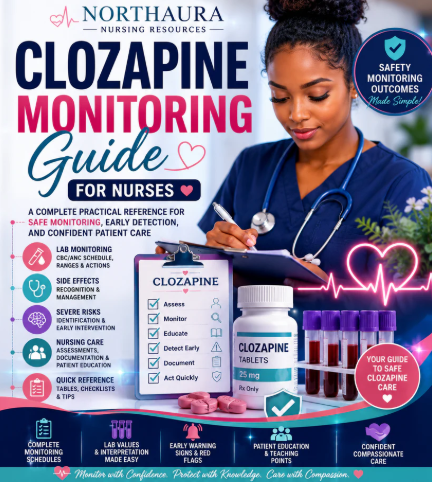
The NorthAura Collection Clozapine Monitoring Survival Guide was built with exactly this in mind — giving nurses and nursing students a reliable, easy-to-navigate reference that brings all of this together in over 30 pages of clinical content. It covers ANC thresholds, titration protocols, side effect recognition, and patient education prompts in a format that’s actually usable during a busy shift, not just in theory.
FAQs
Q: How often does clozapine monitoring bloodwork need to happen?
Weekly for the first six months, every two weeks from months six to twelve, then monthly after a year of stable results. Always follow your regional program and employer protocols — they may vary.
Q: What should I do if a patient’s ANC drops below 1000?
Notify the prescriber immediately and expect the medication to be discontinued. Do not wait for the next scheduled check. This is a time-sensitive situation.
Q: Can a patient restart clozapine after agranulocytosis?
Generally, no. Agranulocytosis is typically considered a permanent contraindication to re-challenge. Some exceptions exist under specialist supervision, but they’re rare.
Q: What’s the biggest clozapine side effect nurses overlook?
Constipation. It sounds minor but it can progress to bowel obstruction — a genuine surgical emergency. Regular bowel assessments are non-negotiable.
Q: Is clozapine monitoring the same for all patients?
Not exactly. Patients with Benign Ethnic Neutropenia require adjusted ANC thresholds to avoid inappropriate medication discontinuation. Know your patient’s baseline.
Keeping It All Together
Clozapine nursing isn’t about fear. It’s about preparation. When you understand the monitoring thresholds, know the side effects worth escalating, and can have a real conversation with a patient about why their weekly blood draw matters, the anxiety gives way to confidence.
The medication that feels intimidating at the start becomes one you manage with clinical clarity. That shift doesn’t happen by accident — it happens because someone sat down and actually learned it.