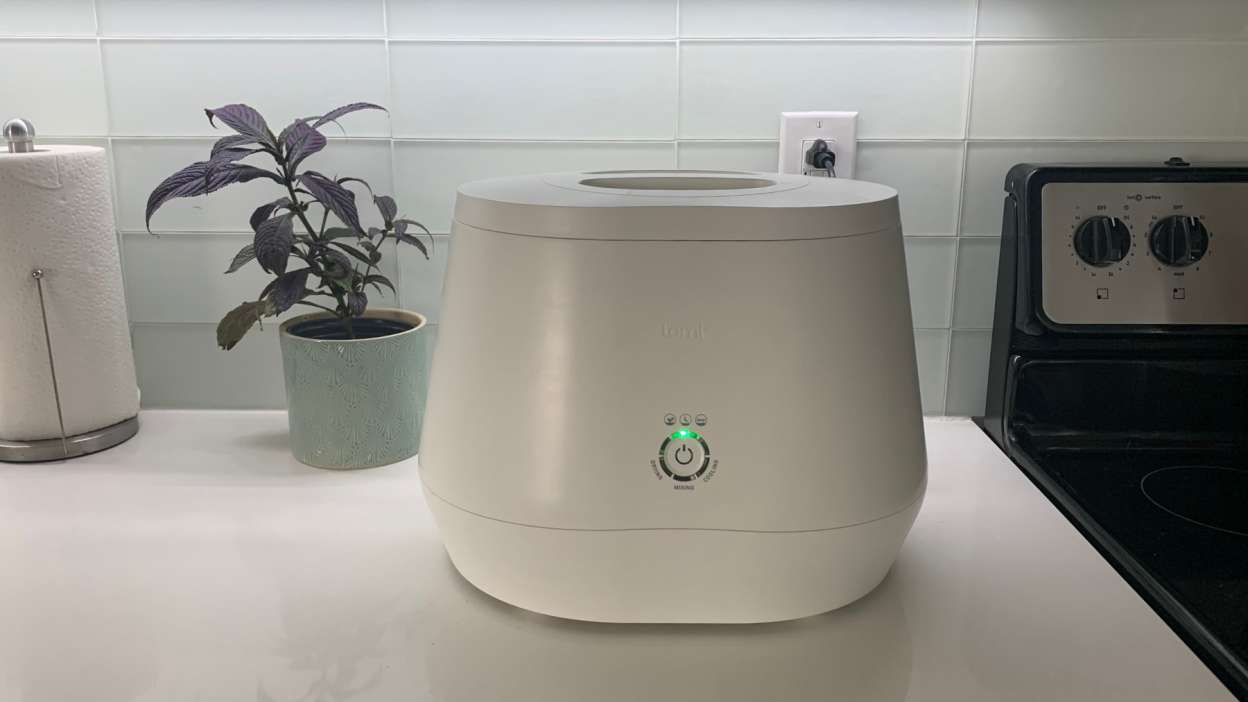
The market for countertop machines that process food scraps has grown quickly over the past few years, and the terminology hasn’t kept up. Some products call themselves composters. Others call themselves food recyclers. Some use both terms interchangeably on the same product page. For buyers trying to compare options, the labeling confusion makes it genuinely difficult to know what a machine actually does before it arrives on the doorstep.
The distinction matters because these two categories produce fundamentally different outputs, and buying the wrong one leads to disappointment that has nothing to do with the machine’s quality.
What a Food Recycler Actually Does
A food recycler, in most cases, dehydrates and grinds. It applies high heat to remove moisture from food scraps, then mechanically grinds the dried material into a fine, lightweight powder or granule. The process is fast, often finishing in two to four hours, and the volume reduction is dramatic. A full bucket of wet scraps becomes a small amount of dry material.
What comes out is not compost. It’s dehydrated, ground food. The organic matter hasn’t been biologically broken down. No microbial decomposition has occurred. The material is shelf-stable and odor-free, which makes it easy to store, but it needs further processing before it becomes something a garden can use directly. Adding it to an outdoor compost pile or mixing it into soil and letting it decompose over time are the most common next steps.
For households that want to reduce trash volume and divert food from the landfill, a food recycler does that job well. But for anyone expecting to scoop the output directly into a planter or garden bed and see immediate plant benefit, the results will be underwhelming.
What a Composter Does Differently
A smart waste kitchen composter that supports biological processing takes a different approach. Instead of relying solely on high heat and grinding, it uses moderate temperatures, extended processing times, and in some cases microbial additives to encourage actual decomposition within the machine. The result is output that contains active microorganisms, available nutrients, and a level of biological maturity that dehydrated scraps don’t have.
This output can go directly into garden soil, potting mixes, or onto lawns at recommended ratios. It functions as a soil amendment from the day it comes out of the machine, without requiring weeks of additional composting. The tradeoff is time. A biologically active processing mode may take 12 to 24 hours instead of two to four, because the machine is doing more than just drying.
Why the Labels Don’t Help
The problem is that both types of machine frequently appear under the same search terms and product categories. A buyer searching for a kitchen composter may end up with a food recycler that only dehydrates, and vice versa. Product descriptions use terms like “nutrient-rich output” and “garden-ready material” regardless of whether the output has been biologically processed or simply dried and ground.
The most reliable way to tell the difference before buying:
- Check whether the machine uses microbial additives or a biological processing mode. If yes, it supports actual composting.
- Look at processing time. Machines that finish in two to four hours are almost always dehydration-based. Machines with cycles running 12 to 24 hours typically include biological processing.
- Read the usage instructions for the output. If the manufacturer recommends adding the output to a compost pile before garden use, it’s a recycler, not a composter.
- Check for compost maturity data. Machines with lab-tested output and maturity scores (like the Solvita index) have documentation that dehydration-only machines do not.
Does It Matter Which One You Choose?
It depends entirely on what you want the output to do. If the goal is simply reducing kitchen waste volume and keeping food out of the landfill, a food recycler handles that effectively. The output stores easily and the cycles are fast.
If the goal is producing a usable soil amendment that feeds plants, improves soil structure, and delivers measurable nutrients, a machine with biological processing capability is the better fit. The cycles take longer, but the output works harder in the ground.
Neither option is wrong. The wrong purchase is the one that doesn’t match the buyer’s expectation, and that mismatch almost always traces back to terminology that blurs the line between two very different machines.