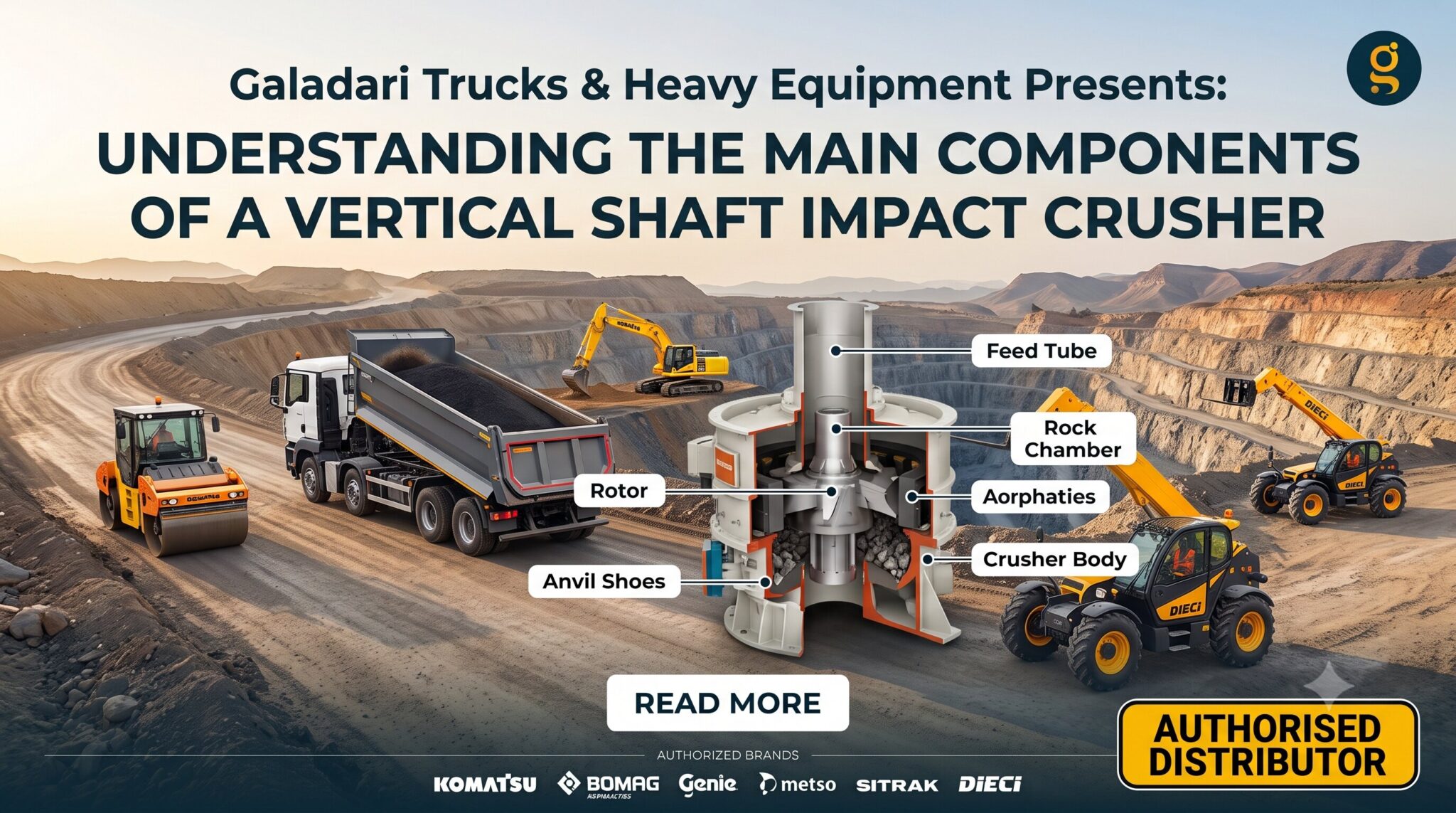
A vertical shaft impact crusher is far more than a simple box with spinning parts. Every element—from the high-speed rotor at its core to the carefully engineered wear surfaces—serves a precise function in transforming raw material into precisely sized aggregates. Understanding these components is essential for anyone operating, maintaining, or designing crushing equipment.
The elegance of vertical shaft impact crusher design lies in its economy of motion. Unlike jaw crushers or cone crushers that rely on mechanical crushing, a VSI uses impact and acceleration to break material. This fundamental difference shapes every design decision, from rotor construction to the discharge configuration. Let’s break down the anatomy of this sophisticated machine.
The Rotor: The Heart of the Vertical Shaft Impact Crusher
The rotor is where all the action begins. Mounted vertically on a shaft, it spins at 1,500–3,000 RPM depending on the machine’s size and design specifications. The rotor’s primary job is simple in concept but complex in execution: accelerate incoming material to high velocity and direct it toward impact surfaces.
A well-designed rotor features:
⚙️
High-Frequency Spin
Rotates at speeds engineered for material acceleration
🔄
Centrifugal Force
Throws material outward toward walls
⚡
Balanced Design
Minimizes vibration during operation
🛡️
Wear Resistant
Uses hardened steel or composite materials
The rotor’s centrifugal force accelerates material radially outward. Material exits through accelerator pockets or channels machined into the rotor’s surface, reaching velocities that generate tremendous impact energy when the particle strikes an anvil or chamber wall.
The Crushing Chamber: Precision-Engineered Impact Zone
Surrounding the rotor is the crushing chamber—a precisely shaped enclosure that orchestrates where and how impact occurs. This isn’t random; every curve and angle is calculated to maximize fragment-generating collisions.
Chamber Design Characteristics:
•Hopper-to-rotor alignment: Material feeds centrally into the rotor to ensure even distribution
•Conical or cylindrical walls: Shaped to redirect material back toward the rotor for multiple impacts
•Impact zones: Specific areas reinforced with hardened wear plates to withstand repeated collisions
•Material circulation: Design allows crushed material to circulate within the chamber until particles are small enough to exit
The chamber’s geometry is critical. A poorly designed chamber forces material out prematurely, resulting in inadequate size reduction. A well-designed chamber keeps material in the impact zone long enough to achieve proper fragmentation.
Anvils and Impact Surfaces: Where Fragmentation Happens
Anvils are the stationary surfaces where accelerated material strikes and breaks. They’re positioned around the chamber perimeter, directly in the path of rotor-accelerated particles. The impact energy transforms rock into smaller fragments through shock and shear forces.
Anvils experience extreme wear—they absorb billions of impacts annually. For this reason, anvils are constructed from specialized manganese steel or composite materials engineered to withstand this punishment while maintaining sharp, angular surfaces that promote clean fractures rather than crushing.
Design Consideration
Modern VSI crushers use reversible or replaceable anvil systems. As surfaces wear, they’re rotated or replaced—extending equipment life and maintaining consistent crushing performance. Some designs use multi-layer anvils where the impact face is replaceable while the structural backing remains in place.
The Feed System: Controlled Material Introduction
The feed system controls how material enters the vertical shaft impact crusher. Poor feed control leads to poor crushing efficiency and uneven product quality. A properly designed feed system:
Distributes material evenly across the rotor centerline. Uneven feeding causes rotor imbalance and excessive vibration. Uniform distribution ensures consistent impact energy and particle sizing.
Controls feed rate to match the rotor’s capacity. Overfeeding causes material to bypass the impact zone without sufficient fragmentation. Underfeeding wastes machine capacity and reduces throughput.
Protects the rotor from oversized foreign objects. An oversized stone or metal fragment striking the rotor at high speed can cause catastrophic damage. Reputable systems include foreign object detection or bypass mechanisms.
Wear Parts and Replaceable Components
Every component that contacts material eventually wears down. The vertical shaft impact crusher design acknowledges this reality by making wear parts accessible and replaceable:
🔩
Anvils
Replaceable impact surfaces
🛠️
Rotor Pockets
Material accelerators that wear gradually
🧱
Chamber Liners
Protective plates on impact zones
⚙️
Bearings
Support the high-speed rotor shaft
Maintenance schedules for these components vary based on feed material hardness and crusher utilization. Limestone wears parts slowly; granite and basalt accelerate wear significantly. Regular inspection and planned replacement schedules prevent unexpected downtime.
The Discharge System: Releasing Finished Product
Material exits the crusher through strategically positioned discharge openings. A well-engineered discharge system:
Allows properly sized material to escape while retaining material that needs additional impacts. This self-classification keeps fragments in the crushing zone until they reach target size.
Minimizes internal wear by directing material flow to bypass the most heavily stressed chamber regions. Some designs incorporate deflectors that guide material toward discharge without forcing it through high-impact zones unnecessarily.
Maintains consistent flow rates, preventing pulsating discharge that complicates downstream processing equipment alignment.
Frequently Asked Questions
Q. How often should I replace the anvils in a vertical shaft impact crusher?
It depends heavily on feed material hardness and crusher duty cycle. For soft materials like limestone in intermittent operations, anvils might last 1,500–2,000 operating hours. For hard aggregates like granite with continuous operation, expect 600–1,200 hours before meaningful wear occurs. A practical approach: inspect anvils monthly. Once they’ve worn smooth and lost their sharp impact edges, crushing efficiency drops noticeably. That’s your signal to replace. Some operators use wear indicators—marked lines on anvil backs—to gauge remaining life. The cost of new anvils (typically £200–500 per set) is minimal compared to the cost of poor size gradation or rotor damage from operating with heavily worn anvils that throw material erratically.
Q. What’s the difference between a VSI crusher and a cone crusher? Why choose one over the other?
The operating principles are fundamentally different. A cone crusher uses mechanical compression—material is squeezed between a moving cone and a stationary bowl. A vertical shaft impact crusher uses impact acceleration. For primary crushing of large rocks, cone crushers win—they handle oversized feed better and are generally more robust for initial size reduction. For secondary and tertiary crushing, especially when you need excellent cubic particle shape and tight size distribution, a VSI excels. VSI crushers produce more uniform, angular particles because the impact and material-on-material collisions break rock along natural fracture planes. If your end product requires well-graded, cube-shaped aggregates (think concrete mix or architectural stone), a VSI typically produces superior results. Cone crushers create more flat/elongated particles due to their compression mechanism. Bottom line: primary crushing → cone crusher. Final product quality → vertical shaft impact crusher.
Q. My VSI crusher keeps vibrating excessively even after recent maintenance. What could be wrong?
Excessive vibration in a vertical shaft impact crusher has several common culprits. First, check rotor balance—an imbalanced rotor is the primary cause. If anvils were recently replaced, verify they’re installed symmetrically around the chamber. Asymmetrical anvil placement throws the rotor balance off immediately. Second, inspect the bearing assembly. Worn bearings allow rotor shaft play that amplifies vibration. Third, examine the crusher foundation—a damaged or improperly leveled foundation transmits rotor vibration directly into your plant structure. Fourth, verify you’re not feeding oversized material that bounces around rather than fragmenting cleanly. Finally, confirm the rotor is spinning at design RPM; incorrect belt tension or motor problems can cause off-speed rotation that feels like vibration. Start with bearing inspection and rotor balance testing—these fix the majority of vibration issues. If problems persist, a vibration analysis with a laser tachometer and accelerometer will pinpoint the exact issue.
Q. Is it worth upgrading to a newer VSI crusher model, or can older crushers keep running indefinitely?
Older VSI crushers can operate for decades with proper maintenance, but newer models often deliver genuine operational advantages. Modern designs incorporate better bearing materials that last longer, improved wear plate geometries that reduce wear by 20–30%, and more efficient rotor designs that reduce energy consumption. If you’re crushing 500+ tonnes daily and your old crusher requires major maintenance every 18 months, the downtime and parts costs might justify replacement with a modern equivalent that requires maintenance every 24–30 months. Calculate total cost of ownership: maintenance costs, downtime losses, and electricity consumption over five years. If maintenance costs approach 15–20% of a new unit’s purchase price annually, replacement becomes economically sensible. That said, if your existing crusher runs reliably with modest maintenance, there’s no urgency to upgrade. Don’t fix what isn’t broken—but track maintenance costs. The moment they spike, start evaluating replacement options.
Thanks, www.glycol.com