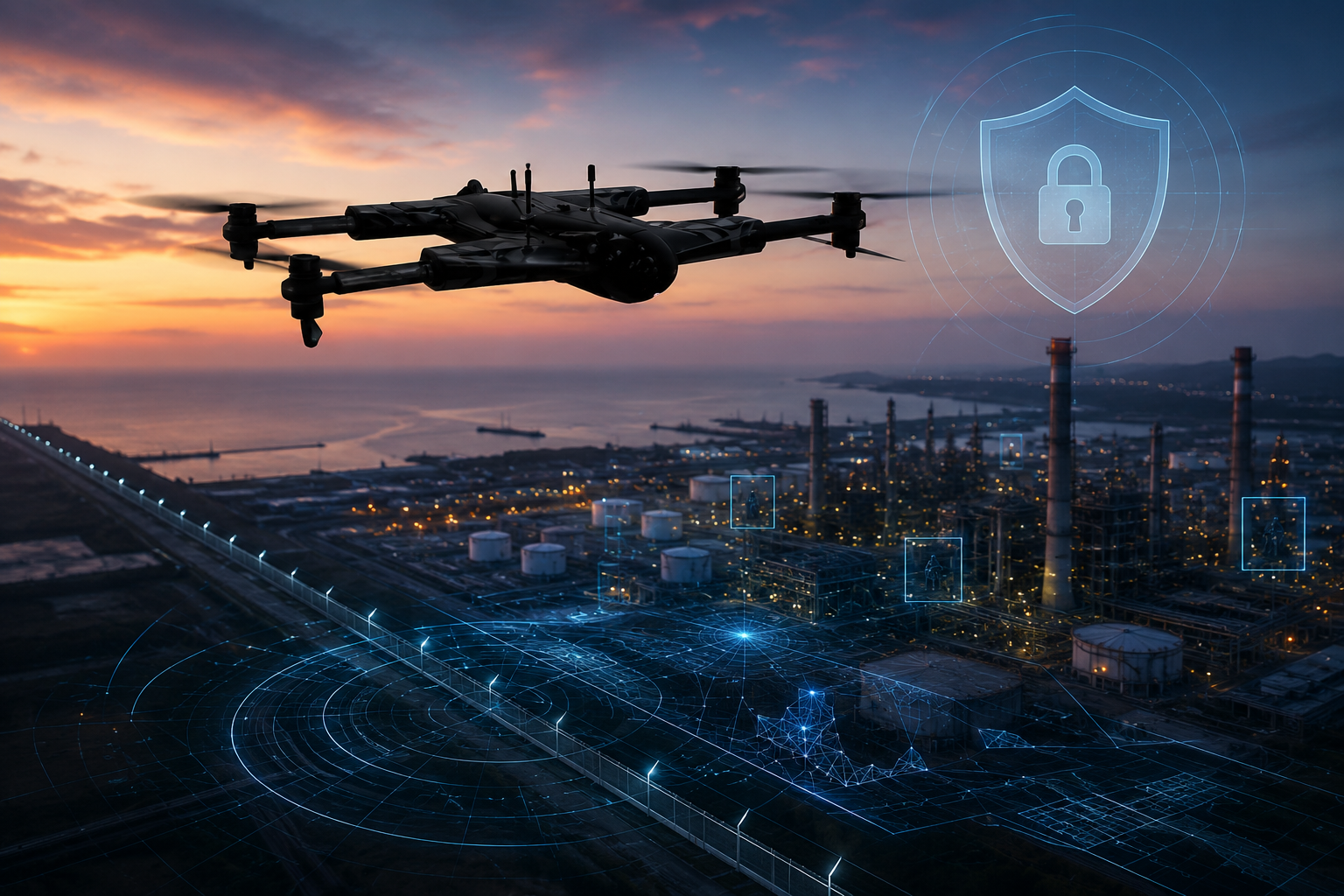
Enterprise security is expanding beyond cameras, fences, access controls, and traditional patrols. Large industrial sites, construction zones, energy facilities, logistics centers, and critical infrastructure often contain remote assets and extensive perimeters that are difficult to monitor continuously from fixed locations.
AI-powered drones are adding a mobile layer to these security systems. Equipped with computer vision, edge AI, autonomous flight capabilities, and advanced sensors, modern enterprise drones can help investigate alarms, monitor perimeters, inspect infrastructure, and collect aerial data.
Among these developments is the emergence of interceptor drones, UAVs designed to rapidly investigate, identify, track, or monitor activity within a defined operational area.
What Is an AI-Powered Interceptor Drone?
An AI-powered drone interceptor system combines unmanned aerial vehicle technology with artificial intelligence and autonomous navigation.
Unlike a basic remotely piloted drone, an autonomous UAV can perform parts of a mission with limited manual control. Depending on its configuration, it may follow predefined routes, navigate toward an alarm location, identify objects, avoid obstacles, collect sensor data, and transmit relevant information to operators.
In enterprise environments, the term “interceptor” should not automatically be interpreted as physically stopping another aircraft. It can refer to intercepting an event or reaching a location quickly enough to investigate and maintain visual awareness.
The objective is typically situational awareness and data collection, with trained personnel retaining responsibility for important operational decisions.
Why Drones Are Becoming Part of Enterprise Security
Traditional perimeter monitoring relies heavily on fixed infrastructure. Cameras, motion sensors, radar, fences, and access-control systems remain essential, but they cannot always provide a useful view of rapidly changing situations.
A drone can move.
If a perimeter sensor detects activity several hundred meters from a security station, for example, an autonomous drone could travel toward the location and provide aerial monitoring before personnel arrive.
This creates a useful workflow:
Detection → Verification → Tracking → Human Response
Instead of replacing existing security technologies, UAVs can complement them.
This approach is particularly relevant for large environments such as industrial campuses, warehouses, construction sites, solar farms, transportation facilities, mines, pipelines, and utility corridors.
How AI Makes Autonomous UAVs More Capable
Artificial intelligence allows drones to do more than transmit video.
Computer Vision for Detection and Tracking
Computer vision enables software to analyze visual information captured by UAV cameras.
Depending on the sensors, algorithms, training data, and environmental conditions, AI drones may assist with identifying people, vehicles, equipment, structural components, smoke, or other objects of interest.
Computer vision can also support object tracking. If an authorized security system identifies movement near a restricted area, a UAV may help maintain visual awareness as the subject moves.
However, AI detection is not infallible. Lighting, weather, distance, object size, camera quality, and training data can influence accuracy. Human verification therefore remains important.
Edge AI for Faster Processing
Sending every video frame to a cloud server can consume bandwidth and introduce latency.
Edge AI allows some processing to occur directly aboard the drone or through nearby computing infrastructure.
For example, instead of transmitting hours of routine footage, a UAV could process imagery locally and flag relevant events for review.
For enterprise security, this approach can support faster decision-making while reducing unnecessary data transmission.
Connecting Drone Security With Infrastructure Inspection
The same aerial mobility used for security can support industrial inspections.
Enterprise drones can access rooftops, towers, pipelines, solar installations, construction areas, bridges, storage facilities, and other locations that may be difficult or hazardous for personnel to inspect frequently.
Depending on the mission, drones may carry RGB cameras, thermal sensors, mapping equipment, or other specialized payloads.
Several enterprise UAV platforms, including systems such as the IQ Interceptor P-1, illustrate the broader movement toward combining autonomous navigation, AI-assisted sensing, and configurable payloads for security and industrial monitoring. Such systems reflect a wider transition in which drones are becoming connected data-collection platforms rather than simply remotely controlled cameras.
Turning Drone Data Into Aerial Intelligence
Collecting imagery is only the first step.
For businesses, the greater value may come from connecting UAV data with GIS, asset-management systems, security platforms, and industrial automation software.
GIS can associate drone observations with specific locations or physical assets. An inspection photograph, for instance, can be connected to a particular section of a roof, pipeline, tower, fence, or construction project.
Repeated flights can then create historical records.
Instead of producing disconnected videos, drone operations can generate structured information such as geotagged photographs, thermal observations, inspection records, maps, timestamps, anomaly alerts, and location data.
This transition from aerial footage to aerial intelligence makes UAV technology more relevant to broader enterprise operations.
Remote Operations and Autonomous Drone Fleets
Another important trend is the move from individual drones toward remotely managed fleets.
Occasional manual flights may be practical for individual inspections. Continuous perimeter monitoring requires a more sophisticated operational model.
Enterprise deployments may involve automated mission scheduling, remote operations, fleet health monitoring, battery management, automated charging, data governance, and centralized supervision.
Beyond visual line of sight, or BVLOS, operations are especially important to this evolution because large facilities and infrastructure networks may extend far beyond the immediate view of a remote pilot.
However, Autonomous flight does not eliminate regulatory responsibilities. Organizations must still consider aviation rules, airspace restrictions, communications reliability, emergency procedures, and human oversight, as outlined in commercial UAS guidance from the Federal Aviation Administration.
Security Drones Also Create Cybersecurity Responsibilities
An autonomous drone is not only an aircraft. It is also a connected computing system.
UAVs may communicate with ground stations, enterprise networks, cloud platforms, mobile applications, GPS/GNSS services, APIs, and GIS databases.
Organizations therefore need to consider encryption, authentication, access controls, software updates, network security, data retention, and logging.
Privacy is equally important. Aerial monitoring can unintentionally capture people, neighboring properties, vehicles, or activities unrelated to the intended mission.
Clear policies governing what data is collected, who can access it, and how long it is retained should therefore be part of enterprise drone programs.
The Future of AI Drones in Enterprise Operations
The next stage of enterprise drone adoption is likely to involve deeper integration with existing security and industrial systems.
A perimeter sensor might detect unusual movement. An autonomous UAV could investigate. Edge AI could analyze imagery. GIS could identify the exact location. A security platform could present the information to an operator, who determines the appropriate response.
Similar workflows can support infrastructure inspection and maintenance.
This is where drones intersect with robotics, smart surveillance, industrial automation, and connected facilities.
Conclusion
AI-powered interceptor drones represent a broader shift in UAV technology—from manually controlled flying cameras toward connected, semi-autonomous systems capable of supporting security, inspection, and data collection.
Computer vision can assist with identifying relevant activity, edge AI can process information closer to the source, GIS can add geographic context, and autonomous flight can reduce repetitive piloting tasks.
Their role should nevertheless be viewed as complementary. Human oversight, cybersecurity, privacy, aviation safety, and regulatory compliance remain essential.
As enterprise drone systems mature, their greatest contribution may be their ability to connect aerial monitoring with the wider digital infrastructure organizations already use to understand and protect physical assets.