Imagine arriving at work one day only to find that everything has stopped. A cyber attack, a flood, or a sudden power failure. For the businesses that saw it coming and prepared, that morning is a manageable crisis. For the rest, it can be the beginning of the end.
This is not meant to scare you. But you must think about it. Disruptions are not rare anymore; they have become a part of the routine. The question is not whether something will go wrong. But how fast can your business stand again when it does? That is exactly what a Business Continuity Plan (BCP) is about.
In this post, we will discuss what a BCP is, why it matters, and how you can create one for your business.
What is a Business Continuity Plan?
A BCP is a documented strategy that outlines how your business will keep running, or get back to running smoothly, when something disrupts normal operations. We are talking about cyberattacks, natural disasters, power outages, supply chain failures, pandemics, you name it.
It is broader than an IT disaster recovery plan, which only focuses on restoring tech systems. A BCP covers people, processes, communication, facilities, vendors, and data. Think of it as your business emergency playbook.
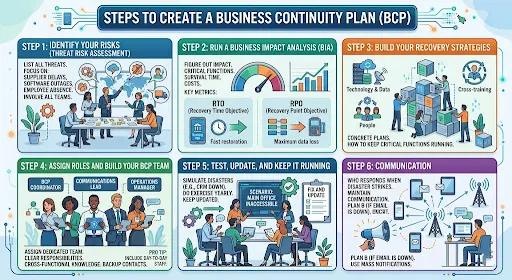
Steps to Create a Business Continuity Plan (BCP)
Step 1: Identify Your Risks (Threat Risk Assessment)
Before you plan, you need to know what you are planning for. You must start by listing every possible threat to your operations. For now, let us skip the dramatic ones like earthquakes and first focus on supplier delays, software outages, employee absence, and beyond.
Ask your team: what single event, if it happened tomorrow, would hurt us the most? This will help you understand the surface risks that leadership had not thought to consider. It is important to involve the people who operate in day-to-day work because they know where the weak spot lies.
Step 2: Run a Business Impact Analysis
Once you know the risks, you need to figure out what their impact would look like. A Business Impact Analysis (BIA) helps you answer: which functions are truly critical, how long can we survive without each other, and what would it cost us?
Use two key metrics here:
- Your Recovery Time Objective (RTO). This helps you understand how fast you need each function back.
Example: To understand this, think of a student or professional managing a strict deadline. In such a situation, if their written work gets vanished or a drive crashes, then they have a very short RTO. So they will reach out to OTHM assignment writing services to quickly restore their progress and meet the deadline. If an online banking system has an RTO of 2 hours, the IT team must fully restore system access within 2 hours of a crash. This is to keep the business compliant and minimise customer dissatisfaction.
- Your Recovery Point Objective (RPO). This identifies how much data or work you can afford to lose.
Example: if a major retailer sets an RPO of 15 minutes, it states that they can afford to lose a maximum of 15 minutes’ worth of transaction data. Hence, backups must run automatically to meet this.
Step 3: Build Your Recovery Strategies
Here is where the plan gets concrete. By this step, you must have identified critical functions in your BIA. Now it is time to identify how your team will keep it running if any function fails.
You can think across these categories:
- Technology and Data: Cloud backups, failure system, recovery sequencing for critical applications.
- Workforce Continuity: Remote work policies, cross-training, backup staffing plans.
- Facilities and Sites: Alternate work locations, access plan if your primary site is down.
- Vendors and Supply Chain: backup suppliers, contract review, third-party BCP verification
- Communication: Who tells whom, when, and through what backup channels.
Step 4: Assign Roles and Build Your BCP Team
A plan without owners is just a document. Assign a dedicated BCP team ideally to people with cross-functional knowledge. Now give each person clear responsibilities. Who activates the plan? Who manages internal communication? Who handles vendors?
Make sure that the contact list includes backup contacts, and each individual must know that the plan is not theoretical. Ownership and accountability are what set the binders on a shelf into something that actually saves a business.
Pro tip:
Do not just assign roles to your senior leadership. Include the people who actually run the day-to-day tasks. They often know the recovery paths that executives might not know.
Step 5: Test, Update, and Keep It Running
This is the step that most businesses skip. You must know that the BCP you wrote three years ago is not updated and is not useful at the current time. Staff changes, technology changes, and so does a business model. Therefore, it is important to update a BCP regularly.
Do this exercise: sit down with your team and give them a scenario. For example, our main office is inaccessible, and the CRM is down. Now see what breaks. Then fix it. Do this exercise once a year and update your BCP if there is any major change.
Step 6: Communication
The final step of creating a BCP is communication. This step takes place as soon as a disaster happens. Your BCP must determine who would be responsible for contacting necessary parties (employees, vendors, investors, etc) and how they will maintain this communication. Many organisations release notifications to cater to a mass audience. But you must also think of plan B if email is down.
Final Words
There is this misconception that large organisations must have all the risk assessment and create BCPs. It is right, but not the only truth. In fact, small businesses are more vulnerable to disasters. They have fewer resources to absorb, so one hit can take down their entire business.
Also, note that there is no compulsion that a BCP has to be a 200-page document. Even a clear and simple plan that identifies the risks and offers basic recovery priorities works.
The businesses that survive disruptions are not lucky. They are always prepared for every kind of problem. So start creating your BCP today, even an imperfect one is better than not having anything.